 Vietnam ☁️ 18°C · Now
Nov-Apr dry — Vietnam's only year-round cool city at 1,500m
Vietnam ☁️ 18°C · Now
Nov-Apr dry — Vietnam's only year-round cool city at 1,500m Da Lat
Vietnam

Da Lat at a glance
As of 2026, Da Lat travel is best in Nov, Dec, Jan, Feb, Mar, Apr, from about $22/day (budget, ex-flights), with a 3-day itinerary. Top sight: Lang Biang Mountain (2,167m).
$22+
Budget tier · excl. flights
From major hubs
DLI (Lien Khuong, 30 km from city center)
Visa-free 90 days
For most Western passports
$1 ≈ ₫26,158
VND · indicative rate
Nov, Dec, Jan, Feb, Mar, Apr
Currently Jun
Highland subtropical (year-round 15-25°C; dry Nov-Apr with morning fog
Now ☁️ 18°C
23:24
ICT (UTC+7)
Vietnamese
basic English in tourism — better than rural Vietnam, less reliable than Saigon; French still understood by some older residents
Why visit Da Lat?
Da Lat sits at 1,500 meters in the Central Highlands of Vietnam — population about 230,000, capital of Lam Dong Province, and the only city in the country where the temperature stays between 15 and 25°C year-round. The French founded it in 1893 as a hill-station retreat from the Saigon heat (the model was British India's Shimla and Dutch Indonesia's Bandung), and the colonial-era nickname 'Le Petit Paris' still describes the older quarters — pine forests, yellow-ochre French villas, an Art Deco railway station, and a 1942 Gothic cathedral with a weather-vane chicken on the spire. For a Vietnamese traveler escaping the 32°C heat of Saigon, the 22°C arrival is borderline magical; for foreign visitors, the appeal is the country's most distinctive cool-weather urban experience packaged at $22-50/day.
The architectural icon and the reason most foreign visitors come at all is the Crazy House (Hang Nga Guesthouse). Vietnamese architect Đặng Việt Nga — daughter of Trường Chinh, Vietnam's second head of state — began building it in 1990 and is still adding to it. The official influences are Antoni Gaudí and Salvador Dalí; the result is closer to a five-story walk-through sculpture of tree trunks, animal-mouth windows, mushroom roofs, and bridges that don't entirely make sense. It's still a working hotel — you can stay in themed rooms (Eagle, Tiger, Bear, Termite, Pheasant, Ant, Gourd) for $30-80/night, but you don't have to in order to walk the public corridors during opening hours. Entry 60,000 VND ($2.50), 8:30-19:00 daily, allow 90 minutes. Passages are tight and stairs are steep — not ideal for claustrophobic visitors or anyone with mobility issues.
Da Lat's second signature site is Linh Phuoc Pagoda in Trai Mat village, 8 km east. Every visible surface — the 49-meter dragon façade, the 36-meter bell tower, the courtyard walls — is covered in mosaic made from broken porcelain, glass, and beer-bottle shards. Inside the main hall sits a 4.9-meter Buddha made entirely from immortelle flowers; in the basement is an 18-level karmic-judgment diorama that is genuinely disturbing for younger kids. Free entry, 8:00-17:00 daily. The most efficient way to reach it is the Da Lat Railway tourist train ($6.50 round-trip), itself a French Art Deco station from 1932 that's one of Vietnam's most photographed buildings; the train runs the surviving 7 km of the old Phan Rang-Da Lat alpine railway and drops you a three-minute walk from the pagoda.
The headline natural attraction is Lang Biang Mountain, 12 km north of the city. At 2,167 m it's the highest peak in the region, sacred to the local K'ho ethnic minority, and the subject of the Lang Biang romantic legend (a Romeo-and-Juliet story between K'ho clans). A 4WD jeep takes you from the visitor center to a viewpoint at 1,950 m (80,000-120,000 VND per seat each way); from there you can walk another 30-45 minutes to the summit, or stop at the K'ho cultural village near the parking lot for traditional houses and gong music. Entry 50,000 VND ($2). The 12-25°C city drops to under 10°C at the summit on December-February mornings — bring a layer. Three nearby waterfalls fill out the day-trip lineup: Datanla Falls (15 km south, $3 entry, the most adventurous because of the canyoning, alpine coaster slide, and zipline operators based here), Pongour Falls (40 km south, $1.50 entry, a seven-tier waterfall 100 m across that is most dramatic August-November after the rains), and Elephant Falls (30 km west, $1 entry, smaller and quieter than the other two).
Around the city center, Xuan Huong Lake is the daily walking ritual — a 7 km loop around a French-built artificial lake, with the 1942 Da Lat Cathedral (locals call it the 'Chicken Cathedral' for the weather vane on the spire), Domaine de Marie Convent (1940, pale-pink exterior, currently housing nuns who sell artichoke jam and bread), and Bao Dai's Summer Palace (1933 Art Deco residence of Vietnam's last emperor, 50,000 VND entry, the rooms preserved as he left them) all within a 20-minute walk from the lake shore. Tuyen Lam Lake, 5 km south of the city, is the quieter alternative — pine-forest setting, kayak rental, and the Truc Lam Zen Monastery (1994, on the south shore) reached by the 2.3 km Da Lat Cable Car ($4 round-trip), Vietnam's longest cable-car ride.
Da Lat is the most legitimate coffee-culture city in Vietnam — not for the Trung Nguyên chain pour you can drink anywhere, but for third-wave specialty roasters working with the small arabica farms in the surrounding Cầu Đất hills. The canonical stop is Tiệm Cà Phê Tùng (1959), a tiny art-deco hole-in-the-wall on Hòa Bình Square where Vietnamese poets, painters, and journalists have hung out for 65 years — order the egg coffee or the salted ice coffee for 25,000 VND ($1) and don't expect WiFi. Mê Linh Coffee Garden, a 1-hour drive into the highlands at Cầu Đất, combines a working arabica plantation, a glass-walled café over a pine-forest valley, and the most photographed coffee view in Vietnam (40,000-80,000 VND drinks, Grab round-trip 400,000-600,000 VND). In the city, La Viet Coffee (Trương Công Định Street) is the specialty roasting flagship — they cup at 9:00 AM, sell whole-bean Cầu Đất arabica at $8-15/250g, and do the best flat whites in town. The Married Beans, K'Ho Coffee (a fair-trade cooperative run by the K'ho ethnic minority that lets you visit the actual farm), and An Cafe (the Instagram-famous yellow-vintage façade) fill out the top tier. A working knowledge of Vietnamese coffee terminology will get you further here than in any other Vietnamese city.
Food in Da Lat is built around the cool-weather produce that doesn't grow elsewhere in Vietnam — strawberries (Đà Lạt is Vietnam's strawberry capital, with you-pick farms charging 80,000-150,000 VND/kg, December-April peak season), artichokes (the Atiso plant grows wild in the surrounding hills and ends up in everything from tea to slow-cooked broth), avocados (the Da Lat butter avocado is the variety used for the famous Kem Bơ green avocado ice cream sold at the central market for $1), and the country's only wine grapes. Vang Đà Lạt, founded in 1990 by the state-owned Ladofoods, is Vietnam's first and largest winery — the cabernet-and-mulberry red is a fixture on Vietnamese restaurant lists and bottles sell for 130,000-350,000 VND ($5-15) at the cellar door tasting. The signature local dish is bánh tráng nướng — a grilled rice-paper 'Da Lat pizza' topped with quail egg, scallions, dried shrimp, and chili sauce, sold from street carts for 15,000-25,000 VND ($1) and best at the Night Market in front of the central market 18:00-22:00. Other can't-miss dishes: bánh căn (mini rice pancakes with quail egg and fish sauce dip, $1-2), nem nướng Ninh Hòa (grilled pork meatballs you wrap with rice paper, herbs, and pickle, $3-5), and bún bò huế at the dawn-only stalls behind the market ($2-3). For sit-down meals, Goc Ha Thanh (BKK1-style northern Vietnamese home cooking, $4-7), Artist Alley Restaurant (modern Vietnamese in a colonial villa, $8-15), and Le Rabelais inside the Dalat Palace Heritage Hotel (1922 colonial dining room, French fine-dining, $30-80) cover the range.
Where to stay reduces to three clusters. The city center (Phường 1, around Hòa Bình Square and the central market) is the canonical first-visit choice — restaurants, cafes, and the Night Market are walkable, hotels range from $15 hostels to $60 boutique 4-stars (Tulip Hotel, Dreams Hotel). Xuan Huong Lake (Phường 6 and 10) is the boutique-and-honeymoon zone — Ana Mandara Villas Dalat ($200-400/night for 17 restored 1920s French villas) and Dalat Palace Heritage Hotel ($150-300, founded 1922 — Jackie Kennedy is the most famous past guest) are the two heritage flagships. Tuyen Lam Lake (south, 5 km out) is the resort-and-quiet option — Swiss-Belresort Tuyen Lam, Edensee Lake Resort, and the Crazy House itself for the genuinely unique stay. A small note on Da Lat hotel pricing: weekends (Saturday night especially) and Vietnamese national holidays push rates 50-100% higher because internal tourism from Saigon spikes — book the weekday Sunday-Thursday window for any non-honeymoon trip.
Getting here is the single biggest trade-off. Lien Khuong Airport (DLI) is 30 km south of the city — there are no direct international flights at all. The only practical route from outside Asia is to fly into Saigon (SGN, 5h30 from Seoul, 22-24h from US East Coast) and connect on a 50-minute domestic with Vietnam Airlines, VietJet, or Bamboo Airways ($30-100 each way). The romantic alternative is the night sleeper bus from Saigon — Phương Trang and The Sinh Tourist run beds-not-seats coaches for 6-7 hours at $10-20, leaving Saigon 21:00-22:00 and arriving Da Lat 4:00-6:00 AM. Nha Trang is 3 hours by mountain-road minivan ($10-15), and the Mui Ne beach pairing is 4 hours by jeep on the highly photogenic switchback road through Bao Loc tea country. From the airport into the city, the shared shuttle bus is 40,000 VND ($1.65, departs every flight, drops at multiple hotels), a metered taxi is 250,000-300,000 VND ($10-12), and Grab is 200,000-280,000 VND.
Currency, payments, and connectivity. Vietnam runs primarily on cash for anything outside hotels and mid-range restaurants — bring USD in small clean bills to exchange at Vietcombank or BIDV (skip the airport and the tourist exchanges, which run 5-7% worse), or use Techcombank or Vietcombank ATMs ($1.50-3.50 per withdrawal). The K-bank and HSBC ATMs accept foreign cards reliably. Cards work at 4-5 star hotels, the larger restaurants in BKK1 and Xuan Huong, and a few cafes (La Viet, Le Rabelais) but not at street food, the night market, or most Grab drivers — assume cash for everything below the $10 ticket. Mobile data is the cheapest in Southeast Asia: a Viettel 7-day 10GB SIM is 100,000 VND ($4) at any city-center phone shop, or Airalo eSIM for the equivalent. 4G is solid in town and patchy outside.
Honest trade-offs. First, there are no direct international flights — Saigon or Hanoi connect plus a 50-minute domestic is the only route. Second, the May-October wet season brings predictable 1-2 hour afternoon storms that can flood the lower streets; the dry November-April window is much smoother. Third, Tết Lunar New Year (late January to mid-February) closes most restaurants, cafes, and shops for 3-7 days — avoid those exact dates. Fourth, English is more reliable than in rural Vietnam but less than in Saigon — keep a translator app open, and assume basic English plus a calculator for any street vendor. Fifth, the city is small — 3 nights covers everything most travelers will want to see, and you'll be looking for excuses past 4. Sixth, scams cluster around three points: the Easy Rider motorbike-guide pitch (genuine guides exist at the $15-25/day rate, but agree on the route in writing and never hand over passport or full payment in advance), the no-meter taxis around the central market (use Grab or Be exclusively), and tourist-tier pricing at Crazy House and Bao Dai Palace (the listed price is the listed price — just confirm it). Seventh, December-February nights drop under 10°C; pack a light jacket, scarf, and long pants.
Bottom line: Da Lat is the canonical 3-night stop on a Vietnam south loop — Vietnam's only year-round cool city, the Crazy House and Linh Phuoc pagoda for architecture, Lang Biang and the waterfalls for nature, and a genuinely interesting coffee-and-wine subculture that doesn't exist anywhere else in the country. The pairing that's worth booking: Saigon 2 nights + Mui Ne 2 nights + Da Lat 3 nights + Nha Trang 2 nights = 9-10 days. Treat it as a slow highland city with cafes and pine forests rather than a major sightseeing capital, and it overdelivers; treat it as a one-night flash visit, and you'll wonder why you came.
Things to do in Da Lat
Highland Nature & Lakes
Lang Biang Mountain (2,167m)
The highest peak in the Da Lat highlands, 12 km north of the city and sacred to the K'ho ethnic minority — the mountain is the setting of the Lang Biang romantic legend (a Romeo-and-Juliet love story between K'ho clans). A 4WD jeep climbs from the visitor center to a mid-mountain viewpoint at 1,950 m; from there you can walk a further 30-45 minutes to the actual summit, or stop at the K'ho cultural village near the parking lot for traditional stilt houses and gong-music performances. Clear-morning summit views span the entire Lang Dong plateau, surrounding pine forests, and the cloud sea on cold December-February dawns.
Pongour Falls
A seven-tier waterfall 100 m wide and 40 m tall, 40 km south of Da Lat — the largest waterfall in Lam Dong Province and dramatically more impressive than the closer Datanla. The water spreads over wide travertine terraces, which means you can wade right up to the lower pools in dry season; in the August-November post-rain peak, the entire cliff face turns into a single thundering sheet. Far fewer visitors than Datanla because of the longer drive (1 hour each way). On the 15th day of the first lunar month (usually late February), Pongour hosts a traditional K'ho festival with gong performances and traditional dance — the only time of year the falls get genuinely crowded.
Datanla Falls + Canyoning
Da Lat's main adventure-tourism site, 15 km south of the city. The falls themselves are modest, but the surrounding canyon hosts the most popular canyoning operation in Southeast Asia — a 1-day course that includes a 25 m abseil down a vertical waterfall, a natural waterslide, a 7 m cliff jump, a longer 11 m optional jump, and a zipline finish. All equipment, helmet, life jacket, English-speaking guide, lunch, and hotel pickup are bundled into one price ($75-100, around 1,800,000 VND). For non-adventure visitors there's also an alpine coaster slide ride down to the base of the falls and a cable car. Highland Sport Travel, Viet Challenge, and DalatTraveltour are the certified operators with the best safety records.
Tuyen Lam Lake + Truc Lam Cable Car
An artificial lake 5 km south of the city center, ringed by pine forest and dramatically quieter than central Xuan Huong Lake. The 2.3 km Da Lat Cable Car (the longest in Vietnam) runs from Robin Hill on the north side of town to Truc Lam Zen Monastery on the lake's south shore — the ride passes directly over the pine canopy and the lake itself, and is one of the best 15 minutes in town for $4 round-trip. The lake side has kayak rental, a small ferry to a forested island, lakeside cafes, and the entrance to Swiss-Belresort Tuyen Lam and Sam Tuyen Lam (the two main lakeside honeymoon resorts).
Xuan Huong Lake (city center)
A 7 km artificial lake built by the French in 1919, smack in the middle of the city — the social heart of Da Lat. The walking-and-jogging loop around it is the local evening ritual (16:30-19:30 is the busiest window); a small horse-and-carriage circuit runs along the south shore (50,000 VND for a slow lap), and swan-shaped pedal boats can be rented at the boat dock at the north end (50,000-100,000 VND for 30 minutes). The Lam Vien Square plaza on the southwest corner is a 24-hour open space with a giant artichoke-flower sculpture — the best free city-night-light photo spot. Sunrise over the lake is genuinely the city's most photographed moment.
French Colonial Architecture
Da Lat Cathedral (Chicken Cathedral)
Built 1931-1942 by the French colonial administration, this is the city's largest Catholic church and the only true French Gothic structure in the Vietnamese highlands. The local nickname 'Chicken Cathedral' (Nhà thờ Con Gà) comes from the metal rooster weather vane perched on the 47-meter spire — a copy of the medieval Gallic-cock weather vanes you'd see on Burgundy parish churches. The stained-glass windows were imported from Grenoble and depict scenes from the New Testament alongside Vietnamese motifs (Catholicism in the highlands has a 150-year history). Sunday Mass at 5:30, 7:00, 8:30, and 16:00 — Vietnamese only, but the choir and the cool incense-filled interior are worth the timing.
Da Lat Railway Station (1932 Art Deco)
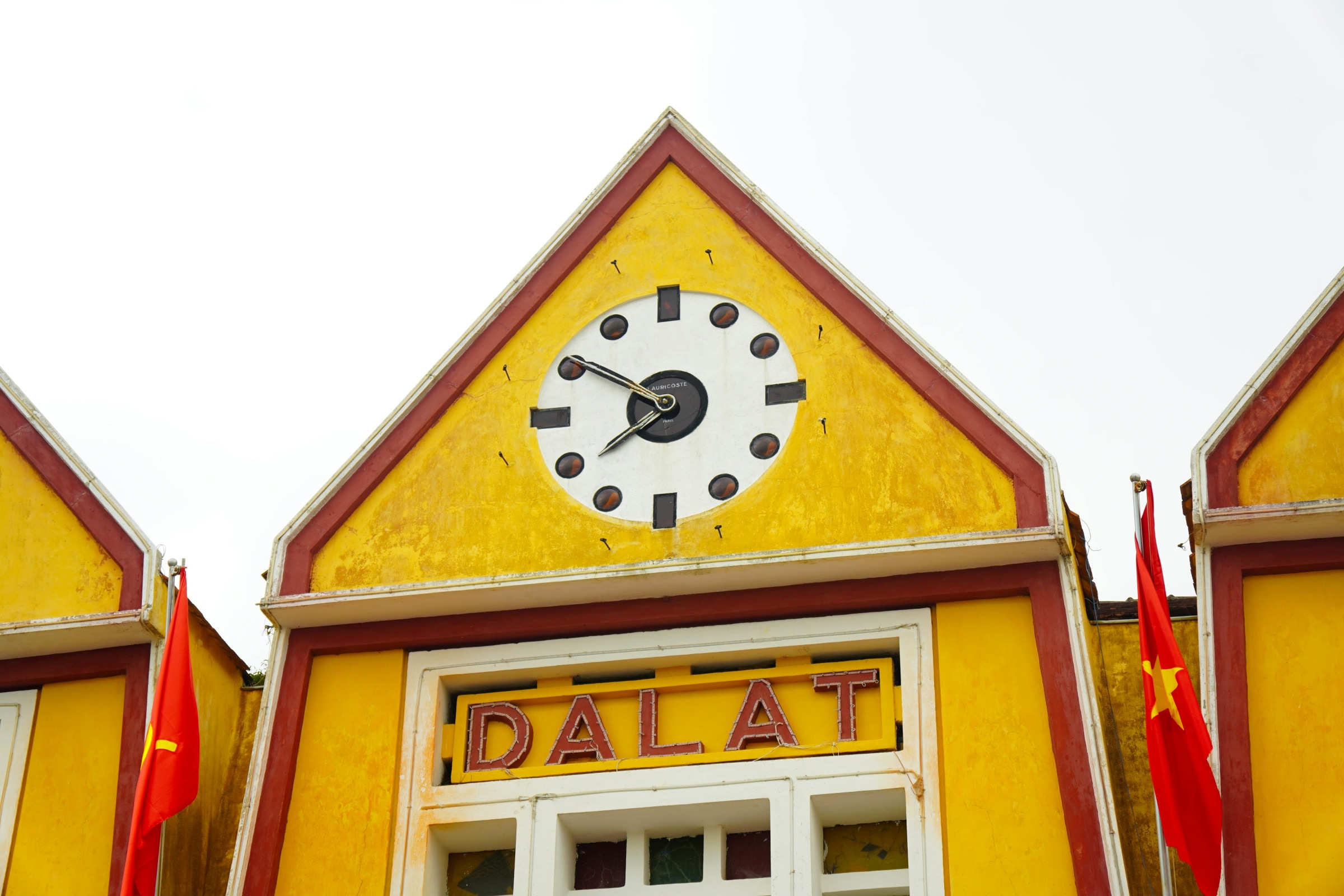
One of Vietnam's most photographed buildings — a 1932 Art Deco station with three steep triangular roofs that deliberately echo Mt Lang Biang, designed by French architects Moncet and Reveron. It served the 84 km Phan Rang-Da Lat alpine cog railway (Vietnam's only rack railway) until 1972, when the line was abandoned during the war. The interior preserves the original ticket counters, wooden benches, and stained-glass clock; outside, you can climb into preserved steam locomotives and a 1930s passenger carriage. Today only the surviving 7 km section to Trai Mat village still operates as a tourist train (5 round-trips daily, 30 minutes each way), which is the best way to reach Linh Phuoc Pagoda.
Bao Dai Summer Palace (Dinh III)
The 1933 summer residence of Vietnam's last emperor Bao Dai (reigned 1926-1945, exiled to France 1955), set in a 26-hectare pine garden 1.5 km southwest of the cathedral. The Art Deco interior is preserved largely as the emperor left it — his study, the family living room, the children's bedrooms, the empress's chambers, and the ballroom where he hosted French colonial officials. There are three Bao Dai residences in Da Lat (numbered I, II, III); Dinh III is the best preserved and the only one currently open to tourists. The optional dress-up service near the entrance ($1) lets you pose in imperial robes for the canonical photo on the front steps.
Domaine de Marie Convent
A pale-pink Romanesque convent built 1940-1944 by the Missions Etrangères de Paris and still housing 100+ Vietnamese Catholic nuns of the Mission Charity order. The single-nave chapel is the architectural highlight — a mix of European Romanesque and Vietnamese Central Highlands materials (the pink color comes from the local laterite). The nuns operate a small bakery and jam-making workshop on the grounds and sell artichoke jam, marmalade, and the famous Domaine de Marie strawberry preserves at a tiny shop near the entrance — the best Da Lat food souvenir at $3-5 a jar. Mass is held Vietnamese-only, but visitors are welcome between services.
Colonial Villa Walking (Trần Hưng Đạo + Yersin streets)
A 1.5 km stretch of Trần Hưng Đạo Street and the connecting Yersin Street, lined with 30+ surviving French colonial villas from the 1920s-1940s. Some are now boutique hotels (Ana Mandara Villas Dalat assembled 17 of these villas into a single 5-star resort), some are private homes, and some are quietly derelict — the streetscape gives the most concentrated 'Le Petit Paris' impression of any neighborhood in Vietnam. The walk takes 45-60 minutes one-way; pair it with a coffee at Ana Mandara's lobby cafe (the only way to step inside the villas without booking a room) and a 1930s-themed dinner at the same property.
Temples & Pagodas
Linh Phuoc Pagoda (Ceramic Pagoda)
Built between 1949 and 1952 in Trai Mat village 8 km east of central Da Lat, this is the most extraordinary Buddhist temple in Vietnam — every visible surface is covered in mosaic made from broken porcelain, glass, and beer-bottle shards (over 10,000 individual pieces). The 49 m dragon façade in the courtyard is made of 12,000 wine bottles, the 36 m bell tower contains Vietnam's largest temple bell (8.5 tonnes), and the main hall contains a 4.9 m Buddha made entirely from immortelle flowers. The basement holds an 18-level karmic-judgment diorama — vivid depictions of Buddhist hell with mechanical figures, genuinely disturbing for kids under 10. Easily the most photogenic Buddhist site in the country.
Truc Lam Zen Monastery
Founded in 1994 on Phung Hoang Mountain above Tuyen Lam Lake, this is the largest Zen meditation monastery in southern Vietnam — over 100 monks and nuns are in residence, following the Vietnamese Trúc Lâm Zen tradition founded by King Trần Nhân Tông in the 13th century. The grounds include a Japanese-style garden, the Lam Vien stupa, and a meditation hall that can hold 200+ practitioners. The simplest way to reach it is the Da Lat Cable Car from Robin Hill — the 15-minute pine-canopy ride is itself a highlight. Free public meditation sessions are held Sundays at 14:00 (Vietnamese only, but visitors of any background are welcome to sit silently).
Linh An Pagoda (Smiling Buddha)
A modest hillside pagoda 25 km west of Da Lat, near Elephant Falls and the Nam Ban silk village. The reason to visit is the 24 m white Maitreya 'Smiling Buddha' statue completed in 2009 — one of the largest Maitreya statues in Vietnam, with a hollow interior you can climb for chest-level views. The pagoda complex is much smaller and quieter than the ceramic-covered Linh Phuoc, with fewer visitors and a stronger sense of working monastic life. Pair with Elephant Falls and the silk village for a half-day western-highlands loop.
Unique Da Lat Attractions
Crazy House (Hang Nga Guesthouse)
Vietnamese architect Đặng Việt Nga — daughter of Trường Chinh, Vietnam's second head of state — began this surrealist five-story walk-through sculpture in 1990 and is still adding to it today. The official inspirations are Antoni Gaudí and Salvador Dalí; the result is closer to a giant tree, with hollow tree-trunk staircases, animal-mouth windows, mushroom roofs, organic bridges between buildings, and themed guest rooms named for animals (Eagle, Tiger, Bear, Termite, Pheasant, Ant, Gourd). The architect lives on-site and is often visible in the courtyard. It's still a working hotel — rooms are $30-80/night and let you sleep inside the building, though daytime visitor traffic means it's not a quiet stay.
Maze Bar (100 Roofs Café)
A seven-floor labyrinth bar and cafe two blocks south of Hòa Bình Square — narrow corkscrew stairs, hidden passages, skull sculptures, surreal painted walls, hidden rooftop terraces, and dead-end alcoves that double as bar nooks. Locally called 'the other Crazy House' because of the similar maze-architecture concept, though it's a single building rather than a multi-villa complex. Drinks are 50,000-100,000 VND ($2-4) and the food menu is fine but not the point — the building itself is the attraction. The 7th-floor rooftop has the best central-Da Lat night-light view in the city.
Da Lat Flower Garden (Dalat Flower Park)
A 7,000-species botanical garden on the northern shore of Xuan Huong Lake — the largest year-round flower display in Vietnam, drawing on the cool highland climate that lets European flowers (roses, tulips, hydrangeas) coexist with native Vietnamese species. The garden hosts the biennial Da Lat Flower Festival every two years in late November (next: 2026), when the entire city center turns into a multi-week flower-installation event. Even outside the festival, the seasonal rotation means there's always something in peak bloom. The entry-gate area rents Vietnamese áo dài (traditional dress) for $4-7 — the canonical Da Lat photo prop.
Da Lat Night Market (Chợ Đêm Đà Lạt)
The city's nightly food-and-clothing market on the steps leading up from Xuan Huong Lake to the central market — 200+ stalls operating 17:00-23:00 daily. The food side is the reason to come: bánh tráng nướng (the Da Lat grilled rice-paper 'pizza' for $1), avocado ice cream Kem Bơ ($1), bánh căn rice pancakes ($1-2), grilled corn and sweet potatoes ($0.50-1), strawberry milkshakes ($1), and night-time hot soy milk with warm steamed corn ($0.50). The clothing side is mostly cold-weather knitwear and Vietnamese-tourist souvenirs — skip unless you actually need a Da Lat-fleece jacket. Saturday-Sunday crowds are extreme; Tuesday-Thursday is much smoother.
Farms & Markets
Strawberry Farm You-Pick (Dalat Hasfarm + small farms)
Da Lat is Vietnam's strawberry capital — over 80% of Vietnamese commercial strawberries grow in the surrounding Cầu Đất and Trại Mát hills. Half a dozen farms operate you-pick visits where you enter a greenhouse, pick by hand, weigh at the exit, and pay by the kilo. The largest, Dalat Hasfarm, is a corporate visit; smaller family farms (search 'Vườn dâu Đà Lạt' in Trại Mát or Cầu Đất) are more authentic, cheaper, and friendlier to non-Vietnamese-speaking visitors. December-April is peak; June-October has fewer berries but the farm-cafe Strawberry Land remains photogenic year-round. Many farms make jam, dried fruit, and strawberry liqueur for sale on-site at half the souvenir-shop price.
Mê Linh Coffee Garden + Cầu Đất arabica plantation
30 km west of central Da Lat at 1,800 m elevation in the Cầu Đất coffee belt — the most-photographed coffee location in Vietnam. A working arabica plantation paired with a multi-level glass-walled cafe cantilevered out over a pine-forested valley, plus a small museum on Vietnamese coffee history and a free walking tour of the surrounding coffee terraces. Drinks are 40,000-80,000 VND ($1.65-3.50) — pin-drip Vietnamese coffee, coconut coffee, salted-coffee variants, and basic Western espresso drinks. Honeymoon and Instagram-favorite; expect 2-3 hour visits including the drive. K'Ho Coffee, a fair-trade cooperative run by K'ho ethnic minority growers, is the more ethical alternative 15 minutes further.
Artichoke + Vegetable Farm Visits
Da Lat is Vietnam's only artichoke-growing region (the Atiso plant arrived with the French in the 1930s and acclimated to the 1,500 m altitude), and the surrounding hills also grow most of the country's commercial broccoli, cauliflower, lettuce, strawberries, and roses. Several family-run farms host visits combining tour, tasting, and tea brewing — Atiso Ngọc Duy and Ladofoods are the two largest with English-speaking guides. The artichoke tea (boiled flower-bud water with raw cane sugar) is Vietnam's most popular detox drink and a worthy souvenir at $5-10/kg dried. Combine with the strawberry farms and a coffee garden for a full agricultural-tourism morning.
Da Lat Central Market (Chợ Đà Lạt)
A four-floor concrete market built in the 1960s at the heart of Hòa Bình Square — the city's main daily food market and the central reference point for navigating Da Lat on foot. The ground floor is produce (cool-weather vegetables, strawberries, avocados, artichokes, flowers — Da Lat is also Vietnam's rose capital), the second floor is clothing and Vietnamese tourist souvenirs (cold-weather knits made on-site), and the upper levels are restaurants and street food. Most active 6:00-10:00 AM and 17:00-21:00 — the late-evening flower section is one of the most photogenic in Vietnam.
Coffee Culture
Tiệm Cà Phê Tùng (1959 — the canonical Da Lat cafe)
A tiny Art Deco hole-in-the-wall facing Hòa Bình Square, open continuously since 1959 — the founder Tùng was a friend of Trịnh Công Sơn (Vietnam's most famous songwriter, who wrote here in the 1960s), and the cafe was the unofficial hangout for Da Lat's poets, painters, and journalists from the 1960s onward. The interior is preserved exactly as it was — wooden bar, glass jars on the back wall, photographs of mid-century Vietnamese writers. The signature is a salted ice coffee or an egg coffee for 25,000-50,000 VND ($1-2). No WiFi, no laptop crowd — just the coffee and the room.
La Viet Coffee (specialty roasting flagship)
The third-wave specialty roaster that put Da Lat on the global specialty-coffee map — La Viet sources micro-lot arabica from the surrounding Cầu Đất farms, roasts on-site (their open-air roaster faces the cafe), and ships beans to specialty cafes across Asia. The cafe itself, on Trương Công Định Street, runs a free public cupping at 9:00 AM (book ahead at laviet.com.vn) — you taste 4-6 micro-lots side by side, learn the Vietnamese coffee terminology, and can buy whole-bean Cầu Đất arabica at $8-15/250g. The flat whites here are the best in Vietnam.
Da Lat Train Cafe
An actual 1930s French-era train carriage parked permanently at the back of the Da Lat Railway Station, refitted as a cafe with the original wooden seats, sliding sash windows, and brass luggage racks intact. The carriage seats about 30 people, faces a small garden, and serves Vietnamese coffee and basic Western breakfast items. Pair with the station visit and the actual tourist train to Trai Mat for a 2-3 hour railway-themed morning.
An Cafe (Instagram yellow facade)
A 2018-opened cafe in central Da Lat that became Vietnam's #1 Instagram coffee location through pure visual styling — yellow vintage-painted exterior, flower-pot-covered balcony, French shutters, red-velvet interior. The coffee is unremarkable (basic Vietnamese pin-drip + coconut coffee + smoothies, 30,000-60,000 VND) but the building is the entire point. Best 14:00-16:00 when afternoon sun lights the yellow wall. Heavy Saturday-Sunday crowds; weekday afternoons are smoother.
K'Ho Coffee (fair-trade cooperative)
A small fair-trade cooperative founded in 2012 by Rolan Cô-Liêng (a K'ho woman) and her Vietnamese-American husband Josh Guikema, operating a 4-hectare arabica farm in Cầu Đất run entirely by K'ho ethnic-minority farmers. The 2-3 hour farm tour ($15-25) includes the coffee-cherry hand-picking demonstration, the natural-process drying patios, hand-roasting on a small batch roaster, and a tasting of three single-origin K'ho lots. Profits return to the K'ho community education and healthcare. Booking is required (kho-coffee.com); the cooperative does not have a walk-in cafe.
Adventure & Activities
Datanla Falls Canyoning (1-day course)
Southeast Asia's most popular canyoning experience — a 1-day course at Datanla Falls covering a 25 m abseil down a vertical waterfall, a natural waterslide, a 7 m cliff jump, an 11 m optional jump, a 35 m 'washing machine' rappel into a foaming pool, and a finishing zipline. All equipment, helmet, wetsuit-top, life jacket, English-speaking guide, lunch, and hotel pickup are bundled in. Run by Highland Sport Travel, Viet Challenge, and DalatTraveltour — the three operators with documented safety records and certified instructors. The 2016 fatal accident involving an uncertified operator is the reason to verify your operator carefully.
Easy Rider Motorbike Tours (1 day to multi-day)
Da Lat invented the 'Easy Rider' concept in the 1990s — you ride pillion on the back of an English-speaking local guide's motorbike, with luggage strapped behind, and they take you to Datanla + Pongour + a coffee farm + Lang Biang on a 1-day loop, or all the way to Mui Ne (1 day), Nha Trang (1 day), or Hoi An (4-5 days) on multi-day cross-country routes. Vietnam's most distinctive overland-travel experience — the multi-day Da Lat-to-Hoi An ride is genuinely one of the best things you can do in Vietnam. Genuine guides exist at the $15-25/day rate (Easy Rider Da Lat, Tony's Easy Rider Tours, Vietnam Easy Rider Tours); high-pressure street touts asking $40+ are best avoided.
Mountain Biking + Trekking (Lang Biang + Bidoup)
The Central Highlands around Da Lat have the densest trail network in Vietnam — Phat Tire Ventures and Groovy Gecko run guided mountain-biking day tours through pine forests, K'ho villages, and coffee terraces ($35-60 with bike, helmet, lunch, transport). For trekking, the Bidoup-Núi Bà National Park (40 km north of Da Lat) hosts the 2-3 day Tà Năng-Phan Dung trek (50 km, the most popular long-distance trek in southern Vietnam) and a series of shorter day hikes around Bidoup Peak (2,287 m, second-highest in southern Vietnam after Lang Biang).
Tuyen Lam Lake Kayaking + Forest Walk
A 1-2 hour kayak on Tuyen Lam Lake — the quieter alternative to central Xuan Huong, set among pine forest 5 km south of the city. Kayak rental ($3-5/hour) at the lakeside dock, plus a forested walking path along the south shore that connects to Truc Lam Zen Monastery. Best November-March for calm clear water; June-September afternoons bring lake mist and occasional storms. Pair with a Tuyen Lam-side cafe lunch.
Wineries & Tastings
Vang Đà Lạt Wine Cellar (Ladofoods) — Vietnam's first winery
Vietnam's first commercial winery, founded in 1990 by the state-owned Ladofoods company in the Lam Dong highlands. The signature Vang Đà Lạt red blend (cabernet sauvignon + Da Lat mulberry + cardinal grape) is on virtually every Vietnamese restaurant wine list and bottles run 130,000-350,000 VND ($5-15) at the cellar door. The Phường 12 cellar offers tastings of 4-6 wines for 80,000-150,000 VND ($3-6), a walk through the production line, and a small museum on Vietnamese winemaking history. The wines won't compete with serious New World labels, but as a Vietnamese cultural-tourism artifact it's genuinely interesting.
K'Ho Coffee + Mulberry Wine Cooperative
A small cooperative in Cầu Đất run by K'ho ethnic-minority families that grows arabica coffee and mulberry wine grapes on the same farm. The 3-hour visit includes a coffee farm tour (hand-picking, natural processing, hand-roasting demonstration), a mulberry-wine tasting (3 vintages), and a Vietnamese highland lunch cooked by the K'ho host family. Profits go to community education and healthcare projects. Book at kho-coffee.com.
Travel cost
Per person, per day (excludes flights)
Hostel + local food + public transport
$22
≈ ₫575,476 VND
Per person / day (excl. flights)
📅 Total cost by trip duration (incl. flights)
3 days
$100
≈ ₫2,615,800
5 days
$160
≈ ₫4,185,280
7 days
$220
≈ ₫5,754,760
Flight estimate: $200-500 from Saigon (50min direct + connecting international from Asia); $700-1,500 from US/EU via SGN; $900-1,400 from Sydney via SGN; $1,200-2,200 from US East Coast via ICN+SGN (round-trip estimate)
Monthly weather
Currently in Da Lat: ☁️ 18°C
Da Lat now (Jun)
High 23°C / Low 16°C· Pleasant
Jan 🌤️
High 21°C / Low 12°C
Mild
★ Best time to visit
Feb 🌤️
High 23°C / Low 13°C
Pleasant
★ Best time to visit
Mar ☀️
High 25°C / Low 14°C
Pleasant
★ Best time to visit
Apr ☀️
High 25°C / Low 15°C
Pleasant
★ Best time to visit
May 🌤️
High 24°C / Low 16°C
Pleasant
Jun 🌤️
High 23°C / Low 16°C
Pleasant
Jul 🌤️
High 22°C / Low 16°C
Pleasant
Aug 🌤️
High 22°C / Low 16°C
Pleasant
Sep 🌤️
High 22°C / Low 16°C
Pleasant
Oct 🌤️
High 22°C / Low 15°C
Pleasant
Nov 🌤️
High 21°C / Low 14°C
Mild
★ Best time to visit
Dec 🌤️
High 20°C / Low 12°C
Mild
★ Best time to visit
Jan
🌤️
21°
12°
Mild
★Best
Feb
🌤️
23°
13°
Pleasant
★Best
Mar
☀️
25°
14°
Pleasant
★Best
Apr
☀️
25°
15°
Pleasant
★Best
May
🌤️
24°
16°
Pleasant
Jun
🌤️
23°
16°
Pleasant
NOW
Jul
🌤️
22°
16°
Pleasant
Aug
🌤️
22°
16°
Pleasant
Sep
🌤️
22°
16°
Pleasant
Oct
🌤️
22°
15°
Pleasant
Nov
🌤️
21°
14°
Mild
★Best
Dec
🌤️
20°
12°
Mild
★Best
Practical information
Getting there
Getting around
Money & payments
Language
Cultural tips
Money & payment
Currency
Vietnam runs on VND (Vietnamese Dong) — 1 USD ≈ 24,500 VND (2026 reference, varies with FX). Prices are quoted in VND; USD is accepted at most hotels and tour-desks but applied at a 5-10% worse rate. Bring USD in clean small bills to exchange at BIDV or Vietcombank (skip airport and tourist exchanges, which run 5-7% worse).
Card acceptance
4-5 star hotels (Ana Mandara Villas, Dalat Palace, Swiss-Belresort), larger restaurants in central and Xuan Huong, La Viet Coffee, Le Rabelais, and Vang Đà Lạt wine cellar all accept Visa/Mastercard. Cash VND for everything else — street food, Night Market, Central Market, Grab drivers, strawberry farms, smaller cafes, motorbike rentals. AmEx and Discover rarely accepted.
Tipping
Not customary at street-food or markets; round up at sit-down restaurants if no service charge is added. $5-10/day for multi-day Easy Rider guides if service was good; $2-5 for spa therapists; $1-2 for hotel housekeeping per night; nothing for Grab drivers (fixed-price app). Vietnamese wages are low and small tips at hospitality businesses do have real meaning but the cultural expectation is genuinely lower than in Thailand or Indonesia.
ATM
Vietcombank, BIDV, and Techcombank ATMs in central Da Lat dispense VND with $1.50-3.50 per foreign withdrawal plus your home-bank fees, and a 3,000,000-5,000,000 VND per-transaction limit (~$120-200). HSBC and K-Bank ATMs accept foreign cards reliably with the same per-withdrawal fees. Bring USD cash from home in clean small denominations as backup — the Da Lat ATM coverage is good but not as dense as Saigon or Hanoi, and outer-district farms or villages have no ATM access at all.
Recommended itinerary
Da Lat 3-day route
Day 1 City Center + Crazy House
10:00
Xuan Huong Lake + Da Lat Market
5km lake walking + central market + Lam Vien Square; free
12:00
Lunch at Goc Ha Thanh (Da Lat local Vietnamese)
Banh mi xiu mai (Da Lat specialty) + bun bo Hue + Vietnamese coffee ¥30,000-80,000
14:00
Crazy House (Hang Nga Guesthouse)
Gaudí-inspired surrealist hotel + organic shapes + maze paths; ¥80,000 ($3.50)
🎫 12% off — Book lowest price16:00
Da Lat Cathedral + Domaine de Marie Convent
1942 pink Catholic cathedral (rooster on cross) + 1942 nunnery; free
18:00
Sunset at Quang Trung Reservoir
Reflective lake + golden hour + free; free
19:30
Dinner at Da Lat Train Cafe (Vietnamese-French fusion)
Vintage train carriage + Vietnamese-French food + craft cocktails ¥150,000-300,000
21:30
Da Lat Night Market + grilled corn + sweet potato
Street food + grilled corn + sweet potato + thick yogurt drink ¥10,000-50,000
Day 2 Linh Phuoc Pagoda + Cable Car + Tuyen Lam Lake
09:00
Linh Phuoc Pagoda (Trai Mat Village)
Mosaic-decorated temple + 49m Buddhist tower + dragon facade made of broken glass; ¥10,000
11:00
Da Lat Cable Car (2.3km)
Vietnam's longest cable car + Robin Hill to Truc Lam Monastery + alpine views; ¥80,000
🎫 16% off — Book lowest price12:30
Truc Lam Zen Monastery + Tuyen Lam Lake
Beautiful Buddhist monastery + lake views + free
14:00
Lunch at Lang Biang Restaurant (lake view)
Vietnamese highland cuisine + grilled fish ¥80,000-200,000
16:00
Tuyen Lam Lake boat ride + pine forest cycling
Boat rental ¥100,000 + bike rental ¥50,000/day
20:00
Final dinner at Le Rabelais (5-star French at Dalat Palace)
Vietnamese highland palace + fine French dining ¥500,000-1,000,000
Day 3 Strawberry farms + Lang Biang Mountain + departure
09:00
Strawberry farm visit + Vietnamese coffee plantation
You-pick strawberry farm + coffee tasting + jam shops; ¥50,000-100,000 entry
🎫 16% off — Book lowest price11:00
Lang Biang Mountain (2,167m) jeep tour
Jeep up Vietnam's iconic mountain + ethnic minority Lat village + 360° views; ¥150,000
13:30
Lunch at Cao Nguyen Restaurant (Lang Biang base)
Vietnamese highland + grilled meat + corn beer ¥100,000-250,000
15:00
Da Lat Flower Park + return
Vietnam's largest flower park + 300+ species; ¥40,000
Where to stay
Click each district to compare hotel deals
City Center (around Xuan Huong Lake)
Da Lat's main lake + market + restaurants + walking distance attractions. Best for first-timers.
See hotels in this area
Crazy House area (Truong Cong Dinh)
Gaudí-inspired Crazy House + boutique cafes + foodie street.
See hotels in this area
Linh Phuoc Pagoda (8km east)
Mosaic dragon temple + cable car nearby + day excursion area.
See hotels in this area
Tuyen Lam Lake (5km south)
Peaceful lake + pine forest + cable car landing + boat rides + camping.
See hotels in this area
Lang Biang Mountain (12km north)
2,167m highest peak + jeep tour + ethnic minority villages + hiking.
See hotels in this area
Strawberry farm zone (5km west)
Vietnam's strawberry capital + you-pick + cafe culture + flower farms.
See hotels in this area
Da Lat hotel price comparison
Compare Booking.com, Expedia, Hotels.com prices in one place
* Centered on City Center (around Xuan Huong Lake) — the most hotel-dense area in Da Lat
Top tours & activities in Da Lat
Top-rated by travelers
Frequently asked questions
Most common questions from travelers to Da Lat
Q How much does a day in Da Lat cost?
Budget $22/day with hostel + street food + Grab + occasional entry fees. Mid-range $50/day with 3-star hotel + Hòa Bình Square restaurants + entry fees + 1 day tour. Luxury $135+/day at Ana Mandara Villas Dalat or Dalat Palace Heritage Hotel + Le Rabelais fine dining + private car day trips. Da Lat is among Vietnam's cheaper highland cities — roughly 20% cheaper than Saigon, similar to Hanoi, dramatically cheaper than Da Nang ($95) or Phu Quoc ($105). Street meals $1-3, sit-down restaurants $4-15, fine dining $20-60, Vietnamese coffee $1-3, Grab in-city ride $1-3. The biggest single variable is hotel — central Phường 1 boutique hotels $20-50/night vs Ana Mandara Villas Dalat heritage rooms $200-400/night.
Q How many days do I need in Da Lat?
3 nights is the canonical sweet spot. Day 1 (arrival): Xuan Huong Lake walking + Da Lat Cathedral + Hòa Bình Square + Night Market dinner. Day 2 (central highlights): Crazy House morning + Bao Dai Summer Palace + Tiệm Cà Phê Tùng + colonial villa walk + Maze Bar rooftop. Day 3 (day trip): Lang Biang Mountain morning + Mê Linh Coffee Garden afternoon, OR Datanla canyoning all day, OR Pongour Falls + K'Ho Coffee + Easy Rider 1-day. Day 4 (departure): Linh Phuoc Pagoda via the Da Lat tourist train morning + flight or sleeper bus back to Saigon. Adding a 4th-5th night lets you fit the 5-day Da Lat-to-Hoi An Easy Rider motorbike journey, a Tà Năng-Phan Dung 2-3 day trek, or a Mui Ne overnight add-on. More than 5 nights and you'll be looking for excuses — the city is small and the headline attractions saturate within a long weekend.
Q When is the best time to visit Da Lat?
November to April is the prime dry window — 15-25°C days, low humidity, the canonical 'cool-Vietnam' experience. December-February is the cool sub-season (night lows under 10°C, often morning fog, jacket required) — pair with the December Da Lat Flower Festival (biennial; next 2026) for the best photography. March-April brings purple jacaranda blooms (Da Lat's most-photographed flowering season). May-October is the wet monsoon — daily 1-2 hour afternoon storms, occasionally heavy enough to flood lower streets, but mornings are usually clear and the green is dramatic. Avoid Tết Lunar New Year (late January to mid-February exact dates vary) — most restaurants, cafes, and tour operators close for 3-7 days. The Da Lat Flower Festival (biennial, late November to early December even years; 2026 next) is the city's biggest annual event but hotels run 50-100% above normal.
Q Do I need a visa for Vietnam to visit Da Lat?
Depends on your passport. South Koreans get 45 days visa-free entry (extended from 30 days in 2023, reconfirmed 2025) — the most generous Vietnamese visa policy for any non-ASEAN nationality. ASEAN nationals (Thai, Singaporean, Malaysian, Filipino, Indonesian, Lao, Cambodian, Bruneian) get visa-free entry for 14-30 days depending on country. For everyone else (US, EU, UK, Australia, Canada, Japan): Vietnam e-Visa $25 single-entry / 90 days at evisa.gov.vn (3-5 working days processing, requires passport photo upload and Visa/Mastercard payment); or $50 multiple-entry. Visa on arrival is technically available but requires a pre-approval letter — e-Visa is the standard recommendation. Passport must have 6+ months validity and 2 empty pages. Note that you fly into Saigon or Hanoi for the international entry, so the visa applies to the entire Vietnam trip, not specifically to Da Lat.
Q Is Da Lat safe for tourists?
Generally very safe — among Vietnam's safer cities. Violent crime against foreigners is rare; the main risks are petty theft (motorbike snatching of phones and bags is more common in Saigon/Hanoi than Da Lat but still happens), Easy Rider guide misrepresentation (verify operators on TripAdvisor, never hand over passport or full payment in advance), and motorbike-rental scams (return-condition disputes are common — photograph the bike thoroughly before riding away). Slippery streets after rain are a real injury risk — closed-toe shoes only on the steep central hills. Pickpocketing at the Night Market and central market is opportunistic but persistent — keep phones in front pockets. Solo female travelers consistently report Da Lat as comfortable any hour in central neighborhoods; outer districts after dark warrant Grab/Be rather than walking. Embassies in Saigon (closest major consular access): Korean +84-28-3822-5757, US +84-28-3520-4200, UK +84-28-3825-1380, Australian +84-28-3521-8100. Emergency: 113 police, 115 ambulance, 114 fire. Most travel advisories rate Vietnam as Level 1 / Normal Precautions.
Q Does English work in Da Lat?
Yes for tourism but with limits. Hotels, tour operators, mid-range and upscale restaurants, Grab/Be drivers, La Viet Coffee staff, and the Crazy House ticket counter all operate in basic English. Below that level (street food, the Night Market, Grab to outer districts, the central market produce floor, K'ho ethnic-minority villages), it drops to gestures plus a calculator plus a typed Google Translate phrase. English in Da Lat is more reliable than rural Vietnam (the internal-tourism economy requires some English from front-line workers) but less reliable than Saigon or Hanoi (which have larger expat populations). French is still understood by some older residents from the colonial generation but is rare among under-50s. Useful basic phrases: 'Xin chào' (hello), 'Cảm ơn' (thank you), 'Bao nhiêu?' (how much?). Most travelers do fine with English alone plus translator apps for the entire trip.
Q What food is Da Lat famous for?
Da Lat's signature is highland-only produce — strawberries, artichokes, avocados, wine grapes — that doesn't grow elsewhere in Vietnam. Iconic dishes: Bánh tráng nướng (Da Lat 'pizza,' grilled rice paper topped with quail egg, scallions, dried shrimp, chili sauce, $1 at Night Market carts), Bánh căn (mini rice pancakes with quail egg and fish-sauce dip, $1-2), Nem nướng Ninh Hòa (grilled pork meatballs wrapped with rice paper, herbs, pickle, $3-5), Kem Bơ (Da Lat avocado ice cream — green avocado puree with coconut milk and condensed milk, $1 at the central market), bún bò Huế (dawn-only stalls behind the market, $2-3). Beverages: Vietnamese pin-drip coffee at $1-3 (the canonical stop is the 1959 Tiệm Cà Phê Tùng), egg coffee or salted ice coffee ($1-2), strawberry milkshakes ($1, Night Market), artichoke tea (the local detox drink, $0.50-1), Vang Đà Lạt wine ($5-15/bottle at the cellar door, Vietnam's first commercial winery). Best restaurants: Le Rabelais at Dalat Palace (1922 colonial fine dining French-Vietnamese, $30-80), Artist Alley Restaurant (modern Vietnamese in a colonial villa, $8-15), Goc Ha Thanh (northern Vietnamese home cooking, $4-7), Lien Hoa Bakery (1989 — Da Lat's bakery institution, $1-3 baguettes and pastries). Souvenir food: Domaine de Marie convent jams ($3-5/jar, the best Da Lat food souvenir), strawberry liqueur (Vang Đà Lạt range $5-10), artichoke tea ($5-10/kg dried).
Q How do I get around Da Lat?
Walking inside central Da Lat (Hòa Bình Square + Xuan Huong Lake + Da Lat Cathedral) covers most attractions in 25 minutes end-to-end. Grab and Be ride-hail are reliable for any city ride ($1-3) and for trips to the Lien Khuong airport ($8-12). Motorbike rental ($5-10/day) is the most efficient option for day trips (Datanla, Lang Biang, Mê Linh) — international driving permit officially required but rarely checked. The Easy Rider concept (pillion on an English-speaking guide's motorbike) is Da Lat's signature and the canonical way to do the Pongour + Elephant Falls + K'Ho Coffee 1-day loop ($15-25/day with verified TripAdvisor operators). Da Lat's central streets are genuinely steep — 10-15% gradients are common, so walking is more tiring than the small map suggests. Bicycle rental ($3-5/day) is not recommended due to the hills, traffic, and frequent rain. No Uber. The Da Lat tourist train ($6.50 round-trip) is the best way to reach Linh Phuoc Pagoda in Trai Mat village. Sleeper bus to Saigon (Phương Trang, $10-20), minivan to Nha Trang ($10-15), and jeep transfer to Mui Ne ($30-50) are all reliable cross-country options.
Q Da Lat vs Saigon — which should I visit?
Both if you have 5+ days — they are completely different cities and only 50 minutes apart by domestic flight or 6-7 hours by sleeper bus. Da Lat: highland cool 15-25°C year-round, French colonial heritage, third-wave Vietnamese coffee culture, Crazy House architecture, Vietnam's only wine country, 3 nights enough. Best for: cool weather, cafes + coffee, colonial architecture, slow pace, romance + honeymoon, photography. Saigon: hot 28-32°C, megacity 10M people, Vietnam War history (Reunification Palace, War Remnants Museum, Cu Chi Tunnels), street food and nightlife, faster pace, the canonical Vietnam entry point. Best for: modern history, urban food, nightlife, day trips to Mekong Delta. If forced to choose only one for a first Vietnam trip: Saigon is the canonical entry city and has more depth for the standard Vietnam-history visitor. Da Lat is the right choice if you want a cool-weather break, are coming primarily for coffee or honeymoon, or are doing a multi-city Vietnam loop. The canonical pairing: Saigon 2 nights + Mui Ne 2 nights + Da Lat 3 nights + Nha Trang 2 nights = 9-10 day Vietnam south loop.
Q Why is the Crazy House worth visiting?
It's genuinely the most distinctive architectural experience in Southeast Asia — a five-story walk-through sculpture that you cannot really compare to anything else in the region. Vietnamese architect Đặng Việt Nga (daughter of Trường Chinh, Vietnam's second head of state) trained in the Soviet Union, returned to Da Lat in 1990, and has been building this Antoni Gaudí + Salvador Dalí surrealist hotel continuously for 35+ years. The result is hollow tree-trunk staircases, animal-mouth windows, mushroom roofs, organic bridges between buildings, and themed guest rooms named for animals (Eagle, Tiger, Bear, Termite, Pheasant, Ant, Gourd). The architect lives on-site and is often visible in the courtyard. Entry $2.50, 90 minutes for the standard public tour. The bonus that nothing else in Vietnam offers: you can actually book a themed room ($30-80/night) and sleep inside the building — the rooms are small and the daytime visitor traffic is loud, but the experience of staying inside a working surrealist sculpture is genuinely unique. Best photographed early morning (8:30-10:00) or late afternoon (16:00-18:00) for golden light on the organic shapes.
Q Is a Vietnamese coffee farm visit worth it?
Yes if you have any interest in coffee — Da Lat is the heart of Vietnam's specialty arabica industry and the surrounding Cầu Đất hills at 1,500-1,800 m altitude produce the country's best beans. Vietnam is the world's #2 coffee producer (after Brazil) by volume but is mostly known for low-grade robusta; the Cầu Đất arabica is the exception, and Da Lat is where the third-wave specialty coffee scene is built. Three tiers of visit: (1) Mê Linh Coffee Garden ($1.65-3.50 drinks + $16-25 Grab round-trip) — the most photographed coffee cafe in Vietnam, a cantilevered glass cafe over a pine-forested valley, honeymoon-and-Instagram favorite, but the actual coffee is mass-market. (2) La Viet Coffee in central Da Lat (free roasting tour + $4-7 cupping by appointment) — the actual specialty roaster supplying cafes across Asia, the best flat white in Vietnam, and whole-bean Cầu Đất arabica at $8-15/250g. (3) K'Ho Coffee fair-trade cooperative ($25-40 farm tour + tasting + lunch) — the ethical visit, run by K'ho ethnic-minority farmers with profits returning to community education and healthcare, requires booking 3-5 days ahead at kho-coffee.com. The canonical Da Lat coffee morning is La Viet 9:00 AM cupping + Mê Linh Coffee Garden sunset — Tiệm Cà Phê Tùng (1959) as an extra context stop.
Q Is Da Lat's cool weather actually worth visiting for?
Yes — Vietnam's only year-round 15-25°C city is genuinely special. The temperature gradient between Saigon (28-32°C tropical heat with high humidity) and Da Lat (22°C cool with low humidity) is dramatic enough that arriving from Saigon feels like flying to a different country, and the appeal is not subtle. The pine forests, French colonial villas, and rose-and-strawberry agriculture create an explicitly European visual feel that doesn't exist anywhere else in tropical Vietnam — locals call it 'Le Petit Paris' and the description is accurate. For South Korean travelers specifically, Da Lat has emerged as a cheaper Hokkaido-style cool-weather destination ($22-50/day vs Hokkaido's $150+/day) with similar cool-air-plus-coffee-culture appeal. For international travelers, the value proposition is the combination — there are cooler Asian cities (Sapa, Kyoto in winter, Chiang Mai briefly) and there are cheaper Asian cities, but Da Lat is the only city that combines year-round cool + French colonial heritage + serious coffee culture + $22/day floor pricing in one package. Pack a light jacket year-round (12-15°C nights), a heavier layer December-February (sub-10°C), and accept that you'll want to spend afternoons sitting in cafes rather than sweating through sightseeing — that's the point of the city.

TripPick
Data-driven travel guide
Weather and exchange rates on this page are fetched live from external APIs; cost and itinerary data are verified periodically against local sources.
Weather
Open-Meteo API
Exchange
ECB rates
Costs
Local price data
Itineraries
Traveler reviews
Book your Da Lat trip
Compare flights, hotels, and tours all in one place
Prices via Skyscanner, Booking.com, GetYourGuide
Go deeper into Da Lat
Click each topic for the dedicated guide
Similar to Da Lat
Same region, similar climate and budget