Vietnam ⛅ 27°C · Now
Nov-Mar dry · Vietnam's only desert · 200+ kitesurf wind days/year
Vietnam ⛅ 27°C · Now
Nov-Mar dry · Vietnam's only desert · 200+ kitesurf wind days/year Mui Ne
Vietnam

Mui Ne at a glance
As of 2026, Mui Ne travel is best in Nov, Dec, Jan, Feb, Mar, Apr, from about $27/day (budget, ex-flights), with a 3-day itinerary. Top sight: White Sand Dunes (Bau Trang).
$27+
Budget tier · excl. flights
From major hubs
No Mui Ne airport — Cam Ranh (CXR, Nha Trang) 90 km / 1.5h or Tan Son Nhat (SGN, Saigon) 220 km / 5h drive; Lien Khuong (DLI, Da Lat) 150 km / 3-4h
Visa-free 90 days
For most Western passports
$1 ≈ ₫26,158
VND · indicative rate
Nov, Dec, Jan, Feb, Mar, Apr
Currently Jun
Tropical dry coast — year-round warm 25-32°C; strong Nov-Mar northeast winds (kitesurf season); short rainy season May-Oct with afternoon showers; sunniest stretch in Vietnam at 2
Now ⛅ 27°C
23:24
ICT (UTC+7)
Vietnamese
limited English in tourism — better than rural Vietnam, weaker than Saigon or Nha Trang; Russian is the second tourist language because of Mui Ne's Russian tourism history since the 2010s
Why visit Mui Ne?
Mui Ne is the small fishing village turned beach-and-desert town on Vietnam's south-central coast — population about 25,000, part of Phan Thiet city in Binh Thuan Province, and 220 km / 5 hours east of Saigon. The headline is unique in Southeast Asia: this is the one stretch of Vietnam with full Sahara-style sand dunes (both red and white), set against a 10 km curved beach with steady 6 m/sec winds Nov-Mar that turn it into one of the top 5 kitesurfing destinations in Asia. For a traveler coming from the tropical-jungle template of the rest of Vietnam, the desert-meets-ocean landscape is genuinely strange in the best way — and for kitesurfers, the 200+ wind days per year and water temperature staying above 22°C make it a winter mecca that pulls riders from Europe, Russia, and increasingly the rest of Asia.
The architectural and natural icon is the White Sand Dunes (Bau Trang), 60 km northeast of Mui Ne center. The scale is genuinely Sahara — kilometers of unbroken white-gold dunes, freshwater crater lakes at the base, and a sunrise palette that turns the sand pink-orange for the 20-minute window before 6:00 AM. The canonical visit is the 4:00 AM sunrise jeep tour (1,500,000-2,500,000 VND for a private 4-person jeep, or 150,000-250,000 VND/person on a shared seat — both include hotel pickup, all four sand-dune-area stops, and return by 9:00 AM before the heat hits). ATV rentals at the dunes themselves run 150,000-300,000 VND for 20-30 minutes on the sand. Combined with the Red Sand Dunes (Doi Hong) 5 km from the village (smaller, redder, used for sunset sledding on plastic boards rented for 20,000-30,000 VND), the dune complex is what made Mui Ne internationally known in the early 2000s.
The signature water attraction is the Fairy Stream (Suoi Tien) — a 1 km natural canyon stream on the western edge of the village where you take your shoes off, wade barefoot through ankle-deep red-tinted water, and walk past sandstone walls striped in white-and-red layers that look like a miniature Antelope Canyon. Entry 15,000 VND ($0.50), 30-45 minutes one-way, best lit 09:00-11:00 before the canyon goes into shadow. The water never gets above the knee and the path ends at a small waterfall. Combined with a sand-dunes morning, this is what most travelers come for as a 1-day Mui Ne summary.
The culture stop is Po Sah Inu Cham Towers in Phan Thiet, 22 km west — a complex of three 8th-9th century Champa Empire Hindu temples to Shiva, built in the same red-brick architectural language as the famous My Son ruins near Hoi An but on a much smaller and quieter scale. Entry 50,000 VND ($2), 30-45 minutes, dramatically less crowded than My Son. The 1762-founded Van Thuy Tu Whale Temple (Phan Thiet, free) holds the world's largest collection of whale bones — 60+ skeletons including a 22 m sperm-whale spine — preserved by the local fishing community whose religion treats whales as sacred protectors at sea. These two sites are the cultural backbone of a Mui Ne trip that goes beyond beach + dunes.
The reason to actually stay 3+ nights, however, is kitesurfing and windsurfing. Mui Ne's 10 km curved beach, steady 15-25 knot Nov-Mar northeast winds, water temperature 22-28°C year-round, and absence of large waves create what kite-school operators reliably describe as one of the world's best combinations for beginners and intermediates. The four canonical schools — C2Sky Kiteboarding (the largest, IKO-certified, 9th-anniversary celebrations 2025), Manta Sail Training Centre (Russian-European clientele, on-site Manta Sail Hotel), Jibe's Beach Club (the 1990s windsurfing pioneer, full beach-club lounge), and Wax Wahine (woman-friendly with women instructors and an on-site boutique hotel) — all run 1-hour intro lessons at $60-90/hr, 3-day full-beginner certifications at $200-400 ($80-150 for 1-day packages), and IKO-level qualifying courses at $800-1,200. Compared with Phuket or Bali kitesurfing pricing, Mui Ne runs 25-30% cheaper for equivalent instruction. Outside the Nov-Mar wind window the schools shift to paddleboard, wakeboard, and beginner-only wind sessions.
Food in Mui Ne is built on the fishing village 5 minutes east of the resort strip — fresh-off-the-boat seafood that arrives daily at dawn and is grilled the same evening at beachfront restaurants and street-side BBQ stalls. The signatures: Mui Ne grilled seafood platter at Sandy Beach Restaurant or beach-side Bo Ke stalls (shrimp 1 kg 250,000-400,000 VND / $10-16, scallops 1 kg 300,000-450,000 VND, lobster Tom Hum 1 kg 700,000-1,200,000 VND / $30-50), Bánh Căn (Phan Thiet's mini rice-flour pancakes with quail egg and shrimp, $1-2 for a 10-piece set at any Phan Thiet street stall), Bánh Xèo (the southern Vietnamese sizzling crepe with shrimp and bean sprouts, 80,000-150,000 VND), Bánh Hỏi (a Mui Ne specialty — woven rice-noodle squares served with grilled pork and herbs, 70,000-120,000 VND), and Lá Lốt (Vietnamese minced-pork meatballs wrapped and grilled in betel leaves, served with rice paper for DIY-wraps, 80,000-150,000 VND). The drinks side is simpler — Bia Saigon and Bia Larue local lagers at 20,000-30,000 VND, Vietnamese coffee the iced sweetened condensed-milk cà phê sữa đá at 25,000-50,000 VND. Sandy Beach Restaurant for the canonical seafood-BBQ evening, Forrest Restaurant for sit-down seafood with English-Korean menu, Joe's Café (since 1996, the village's original Western-and-Vietnamese late-night hangout with nightly live music 19:00-22:00), Lotus Village Restaurant for the Bánh Căn-and-Bánh Xèo set Vietnamese platter, Sandals Restaurant at Mia Resort for the upscale honeymoon-dinner option ($25-50 with sunset terrace seats), and Wax Wahine Restaurant for the kitesurf-and-cocktail evening with vegan options round out the top tier.
Where to stay reduces to three clusters. Mui Ne Beach (Hàm Tiến) is the canonical first-visit choice — the 10 km main resort strip with restaurants, kite schools, and the Anantara, The Cliff, Mia, and Cham Villas pool-villa honeymoon properties ($150-450/night for 4-5 star, $50-100 for 3-star) all walkable. Suoi Tien (east end, near Fairy Stream) is the quiet-couples zone with smaller boutiques and the Cocosand garden-restaurant scene ($40-90/night). Phan Thiet city (22 km west, the actual provincial capital) is the budget-and-local zone where rooms run $20-50, restaurants are a third of resort-strip prices, and you trade beach access for a 15-minute Grab ride. A small note on Mui Ne pricing: kitesurfing season (Nov-Mar) pushes resort rates 30-50% above off-season, and Lunar New Year (Tết, late Jan-mid Feb) plus Christmas-NY both run another 50-100% on top. Book Apr-May or Oct shoulder for the best value — wind is gone but beach + dunes + temples are all still available.
Getting to Mui Ne is the single biggest trade-off. There are no direct international flights — the standard route is to fly into Saigon (SGN, 5h30 from Seoul, 22-24h from US East Coast), then take a 5-hour sleeper bus ($15-20 with Phương Trang, Sinh Tourist, or Hanh Cafe, beds-not-seats, 8-10 departures daily, 22:00 night bus is popular for arriving 03:00 in time for the sand-dunes sunrise jeep) or a 5-hour private car ($50-80 each way). The faster alternative is to fly into Cam Ranh (CXR, Nha Trang) and drive south 1.5 hours / 90 km — useful if you can find a Seoul-CXR direct on Jin Air or T'way ($350-650 round-trip). Da Lat (Lien Khuong, DLI) is 3-4 hours by jeep on the photogenic Bao Loc switchback road — the canonical pairing for a Vietnam south-loop. There is no rail to Mui Ne itself — the closest is Phan Thiet station (15 km west), which connects to Saigon by a 4-hour scenic morning train at $10-15.
Currency, payments, and connectivity. Vietnam runs primarily on cash for anything outside the 4-5 star resorts and the larger beach-strip restaurants — bring USD in clean small bills to exchange at BIDV or Vietcombank in Phan Thiet or Saigon (skip the airport and tourist exchanges, which run 5-7% worse), or use Vietcombank or BIDV ATMs ($1.50-3.50 per withdrawal). Cards work at Anantara, The Cliff, Mia, Sandals Restaurant, and a few cafes (Joe's, Wax Wahine) but not at street-food, beach BBQ, beach-side massage, or most Grab drivers — assume cash for everything below the $10 ticket. Mobile data is among the cheapest in Southeast Asia: a Viettel 7-day 10GB SIM is 100,000 VND ($4) at any Phan Thiet phone shop or Saigon airport, or Airalo eSIM for the equivalent. 4G is solid along the main beach strip but patchy at the White Dunes and on coastal roads outside Phan Thiet.
Honest trade-offs. First, there are no direct international flights — Saigon + 5 hour drive, or Nha Trang + 1.5 hour drive, is the only route. Second, outside the Nov-Mar wind season the kitesurfing and windsurfing simply stop — Apr-Oct is beach-and-dunes-only and most kite schools run at reduced operations or close entirely. Third, the rainy May-Oct season brings short afternoon thunderstorms that don't ruin trips but do close the canyoning-style activities and limit boat trips; July-Sep is the cloudiest stretch. Fourth, the village is genuinely small — 2-3 nights is enough for non-kitesurfers, and you'll be looking for excuses past night 4 unless you're learning to kite. Fifth, English is more limited than in Saigon or Nha Trang — keep a translator app open and use Grab for transport rather than haggling with motorbike-taxi drivers. Sixth, the Russian tourist scene is unusual but not problematic — some hotels and restaurants have Russian-only menus or staff, a leftover of the 2010s Vladivostok-to-Cam Ranh direct flight era; international tourism is rebuilding post-2022 with the Korean, Chinese, and Western segments growing. Seventh, scams cluster around three points: jeep-tour negotiation (1,500,000-2,500,000 VND private or 150,000-250,000 VND/person shared is the real price — anything above is foreigner markup, walk away and book at hotel reception or via Klook/GetYourGuide), beach-massage and fruit-vendor hassle (negotiate price before service, walk away from anyone who hands you something without quoting a number), and the no-meter taxi scene at Phan Thiet bus stations (use Grab and Be exclusively).
Bottom line: Mui Ne is the canonical 2-3 night beach-and-desert add-on to a Vietnam south loop — Vietnam's only true desert, the most photogenic fishing-village basket-boat scene in the country, world-class kitesurfing Nov-Mar, and a Cham-temple history layer that gives the trip more depth than pure beach. The pairing that's worth booking: Saigon 2 nights + Mui Ne 2-3 nights + Da Lat 3 nights + Nha Trang 2 nights = 9-10 days for the full south-Vietnam tour. Treat it as a slow desert-and-beach stopover with one big sunrise day and one full kitesurf day, and it overdelivers; treat it as a city-style destination with restaurants and museums, and you'll wonder why you came.
Things to do in Mui Ne
Sand Dunes & Desert
White Sand Dunes (Bau Trang)
60 km northeast of Mui Ne, Bau Trang is the headline Sahara-style dune complex of Vietnam — kilometers of unbroken white-gold sand with freshwater crater lakes at the base, and a sunrise palette that turns the entire landscape pink-orange for a 20-minute window before 06:00. The canonical visit is the 04:00 AM jeep-tour pickup from your hotel, arriving at Bau Trang in time for the 05:30-06:00 sunrise, with 90 minutes on the dunes for ATV rides and photography before the heat starts climbing past 09:00. Scale-wise this is genuinely Sahara — easily the most distinctive natural landscape in southern Vietnam and the single Mui Ne shot you'll see in every guidebook.
Red Sand Dunes (Doi Hong)
The smaller, redder dune complex 5 km from Mui Ne center — easily reachable on a motorbike or short Grab ride and the canonical sunset stop on a Mui Ne afternoon. The sand is rust-red due to the same iron-oxide that colors Vietnam's central-highland coffee soil, and the dunes are 20-50 m high and walkable end-to-end in 30 minutes. Plastic sledding boards are rented at the base for 20,000-30,000 VND and locals will help kids slide down the steeper south face. Less impressive in scale than the White Dunes but dramatically more accessible, and the late-afternoon photography (16:30-17:30) is the most photogenic single hour in Mui Ne.
Fairy Stream (Suoi Tien)
A 1 km natural sandstone canyon stream on the western edge of Mui Ne village — the most-photographed land attraction in town and a strange-feeling barefoot walk through ankle-deep red-tinted water flanked by white-and-red striated cliffs that look like a miniature Antelope Canyon. The entrance is unmarked tourist infrastructure — you pay the 15,000 VND fee at a metal kiosk, take off your shoes (locals will keep them safe for a 5,000-10,000 VND tip), and wade upstream for 30-45 minutes to a small waterfall where the canyon ends. Water level never gets above the knee even in rainy season. The canyon is most photogenic 09:00-11:00 when direct sun hits the eastern wall.
Lotus Lake (Bau Sen)
A natural lotus-flower lake adjacent to the White Sand Dunes complex — pink lotus blossoms peak in July-September, but the lake itself is photogenic year-round with floating water lilies, reflected sky, and the white dunes visible in the background. Most jeep tours include a 15-20 minute photo stop here at sunrise on the way back from Bau Trang; standalone visits are pointless unless you're already at the White Dunes. The east edge has a small fishing-boat dock and a few local food stalls serving banh xeo and grilled corn at sunrise hours.
Yellow Sand Dunes (between Red and White)
The smaller mid-tier yellow-toned dunes between Bau Trang (white) and Doi Hong (red), about 30 km from Mui Ne village. Most jeep tours stop here for 15-20 minutes as the third dune stop, primarily for ATV rides on the gentler slopes (these dunes are 10-20 m high rather than the 50+ at Bau Trang). Skippable on its own; worth doing inside a full sunrise jeep tour because it's already paid-for.
Beaches & Resorts
Mui Ne Beach (Hàm Tiến)
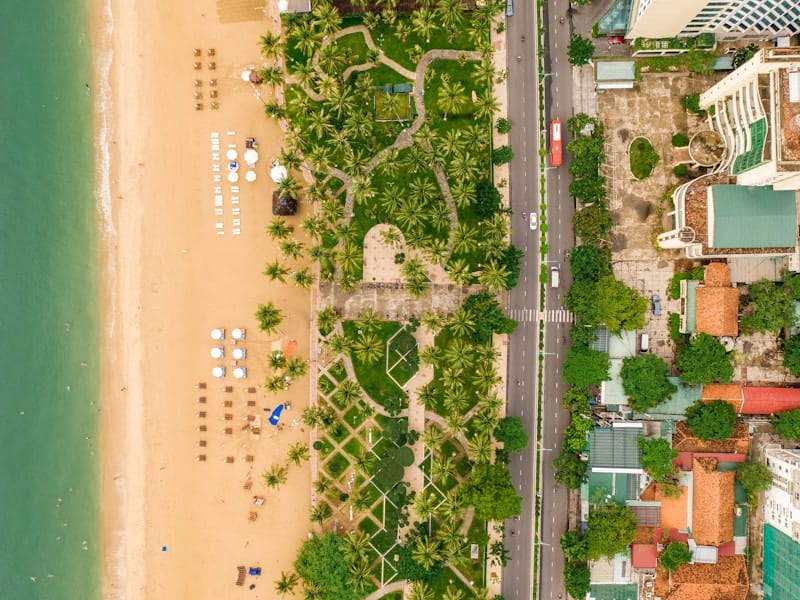
The 10 km curved main beach that defines Mui Ne — a single resort strip running east-west along Nguyen Dinh Chieu Road, lined with 4-5 star resorts, kite schools, beach-side seafood restaurants, and the village's best swimming and sunset sections. The beach is wide enough for casual football and sunset volleyball, and clean enough at the resort frontages, but the public-access middle stretches collect Vietnamese-tourism plastic on windier days. Kitesurfing dominates the eastern half during Nov-Mar wind season, so the western half near Anantara and Cliff Resort is the calmer swimming zone. The water temperature stays 22-28°C year-round — among the warmest swimmable beaches in Vietnam.
Hon Rom Beach (Suoi Nuoc)
The quieter eastern-end beach 6 km past Mui Ne village — primarily a local-tourism destination with fishing boats, low-rise hotels, and one or two small resorts. The beach is steeper, sandier, and dramatically less crowded than the Hàm Tiến strip; you can typically walk 200 m without seeing another person on weekdays. The downside is that the water gets choppy in the kite-wind months and the lifeguard presence is minimal. Pair with the Mui Ne Fishing Village at dawn for a full Mui Ne-east morning.
Anantara Mui Ne Resort beach + pool day-pass
Anantara Mui Ne is Mui Ne's flagship 5-star ($300-450/night) at the western end of the Hàm Tiến strip — and the day-pass to its beach club, two infinity pools, and beach-restaurant terrace ($30-50) is the canonical way to upgrade a mid-range Mui Ne stay for one afternoon without paying for the whole resort. The beach access is the cleanest stretch of Mui Ne and the pool area runs straight to the sand. Best Nov-Mar afternoons when the western-end winds drop and the pool deck has the full sunset view.
Suoi Tien Beach (east end, near Fairy Stream)
The small public beach right next to the Fairy Stream canyon entrance — short on amenities but the most photogenic Mui Ne beach for the canonical canyon-meets-ocean shot. Local fishing boats moor here in the early morning and the basket-boat tradition is most visible. Best paired with a Fairy Stream walk plus a 30-minute beach sit before the heat gets uncomfortable past 10:00.
Fishing Village & Markets
Mui Ne Fishing Village (dawn basket-boat scene)
The 1.5 km strip of working fishing village 5 minutes east of the Mui Ne resort strip — a genuinely active commercial fishing community of 300+ wooden boats, 50+ traditional thuyen thung (round bamboo-and-resin coracle boats unique to coastal central Vietnam), and a beachfront fish-market that runs 05:00-08:00 every morning with the night's catch being weighed, auctioned to wholesalers, and trucked to Phan Thiet and Saigon. For 5:30 sunrise, this is the most photographed fishing-village scene in Vietnam — the basket boats stacked on the beach, the silhouettes of fishermen sorting nets, and the warm pink-purple light over the cove are genuinely unique to Mui Ne. Visit by 05:30 AM and you'll have the place to yourself; arrive after 07:00 and the fleet is mostly out at sea.
Phan Thiet Central Market (Cho Phan Thiet)
The provincial-capital indoor-and-outdoor market 22 km west of Mui Ne — the city's main daily food market and the place to see authentic Vietnamese commerce without the resort-strip markup. The ground floor is produce (Phan Thiet is famous for dragon fruit — Vietnam's biggest growing region — and the market is where the cheapest tier comes through), the second floor is clothing and Vietnamese-tourism souvenirs, and the alley around the back houses the seafood section with whole fish, squid, scallops, and lobster at half resort-strip prices. Most active 05:00-09:00 and 16:00-19:00.
Phan Thiet Night Market
The 17:00-23:00 evening market at the western end of the Phan Thiet bus station area — street food, seafood BBQ, fresh fruit, and Vietnamese-tourism kitsch (knitwear, embroidered bags) at 30-50% of Mui Ne resort-strip prices. The street-grill section is the reason to visit — local shrimp BBQ at 150,000 VND/kg, grilled scallops at 100,000 VND for 12, and Bánh Xèo at 40,000 VND/plate. Considerably more authentic than the Mui Ne village night-market scene which is heavily tourist-priced.
Mui Ne fishing-village beach BBQ stalls
The 5-7 informal beachfront BBQ stalls between the fishing village and the village's eastern resort strip — plastic chairs on the sand, fresh-from-the-boat seafood at the shopkeeper's choice (shrimp 1 kg, scallops, fish), grilled over coals while you wait. Per-kg prices are negotiated up front and are the cheapest way to eat seafood in Mui Ne (about 40-50% of Sandy Beach or Sandals restaurant prices). The setting is genuinely village rather than tourist-resort.
Kitesurfing & Windsurfing
C2Sky Kiteboarding (IKO-certified flagship)
Mui Ne's most-established kite school — IKO-certified instructors (the international kitesurfing standards body), 9+ years of operation, large student volumes (50+ daily during peak Nov-Mar), and the most reliable English-language instruction in Mui Ne. The full beginner certification course is 3 days, includes equipment (kite, board, harness, helmet, life jacket), instructor radio communication, and finishes with an IKO Level 2 sign-off that's recognized by kite schools globally. Located mid-strip on the Hàm Tiến main beach.
Manta Sail Training Centre
The European-and-Russian-clientele alternative to C2Sky — Manta Sail has been training Mui Ne riders since 2009, has its own on-site Manta Sail Hotel (a kite-school-and-accommodation package very popular with Russian and German guests), and runs both kitesurfing and windsurfing. The Russian-and-English bilingual instructor base is the distinguishing feature; the rest of the operations are roughly equivalent to C2Sky. Located at the eastern end of the main beach near the kitesurfing zone.
Jibe's Beach Club (1990s windsurfing pioneer)
The original Mui Ne windsurfing pioneer — Jibe's has been operating since the early 1990s when Mui Ne was still primarily known for fishing, and is the canonical windsurfing-rather-than-kitesurfing school in the village. Full beach-club setup with restaurant, lounge, equipment rental, instructor lessons, and overnight beachside bungalows. Beyond the lessons, the lounge is one of the best places in Mui Ne to sit through a sunset with a beer and watch the wind sports finish for the day.
Wax Wahine Kite School (woman-friendly)
The smaller women-instructor-led kitesurfing school in Mui Ne — Wax Wahine was founded specifically as a more welcoming environment for solo women travelers and women-led beginner instruction. The same IKO-certified standards as C2Sky and Manta Sail, but with women instructors and a quieter student-to-instructor ratio. Pairs with the on-site Wax Wahine Hotel + Restaurant, which is itself one of the better Mui Ne mid-range stays with kitesurfing-focused amenities.
Temples & Cham Heritage
Po Sah Inu Cham Towers
A complex of three small 8th-9th century Champa Empire Hindu temples on a low hill at the eastern edge of Phan Thiet city, 22 km west of Mui Ne village — built by the Cham people, who ruled most of central-southern Vietnam between the 2nd and 17th centuries before being absorbed by the Vietnamese kingdom. The three towers are dedicated to Shiva, Nandi (the bull), and a god-king of the Cham; the architectural language (red brick, square base, pyramidal tower) is the same as the more famous My Son ruins near Hoi An, but Po Sah Inu is much smaller, dramatically less crowded, and Vietnam's southernmost surviving Cham temple complex. Best for the late-afternoon photography (16:00-17:30 west-facing light) and a small free-standing museum showing Cham linga sculptures.
Van Thuy Tu Whale Temple (Phan Thiet)
Vietnam's largest collection of whale skeletons — over 60 preserved sperm-whale, fin-whale, and humpback bones, including a 22 m sperm-whale spine that hangs from the rafters of the main hall — housed in this 1762-founded Buddhist-Vietnamese coastal-fishing temple in central Phan Thiet. The local fishing community treats whales as sacred protectors at sea (a tradition shared across coastal South China Sea fishing cultures), and beached or dead whales receive the same funeral rites and ancestral worship as human ancestors. Genuinely strange and quiet — most international visitors don't make it here, but it's one of the most distinctive temple visits anywhere in Vietnam.
Linh Long Tu Pagoda (Mui Ne village)
A small working Buddhist pagoda on the outskirts of Mui Ne village — primarily a local-worship space rather than a tourist destination, and the closest active Buddhist temple to the resort strip. The complex is quiet and small (about 15-20 minutes to walk through), and is most interesting on the first and 15th of the lunar month when local fishing families come for blessings before going to sea. Genuine working monastic environment — not on any standard Mui Ne itinerary but worth the 15-minute stop if you're already in the village.
Ke Ga Lighthouse (30 km south, 1899 colonial)
Vietnam's oldest French-colonial lighthouse, built 1897-1899 on a small offshore islet 30 km south of Mui Ne — 65 m tall, 184-step internal climb, and a working navigation light to this day. The visit involves a 5-minute basket-boat or motorboat ride from the mainland (depending on tide), a 184-step climb to the top, and a 360° view across the southern Vietnamese coast. The surrounding cove is genuinely quiet and the beach below the lighthouse is one of the cleaner Mui Ne-area swimming spots. Drive-yourself is the practical option — Grab won't cover this distance.
Ta Cu Mountain Reclining Buddha (1 hour south)
A 49 m reclining-Buddha statue — Asia's longest at the time of construction — at the top of Ta Cu Mountain (475 m), 30 km south of Mui Ne. The visit is accessed via a 1.6 km cable car (10 minutes each way) followed by a 15-minute walk to the statue itself. The statue dates from 1962 and the surrounding Buddhist temple complex is genuinely active with resident monks. Reasonably quiet for a Vietnamese Buddhist site, and the cable-car ride alone is worth the price.
Food & Restaurants
Sandy Beach Restaurant (the canonical seafood-BBQ)
The most-recommended seafood-BBQ restaurant on the Hàm Tiến main beach — long-running, English-speaking, and the place most travelers eat their first Mui Ne seafood meal. The format is standard: walk to the seafront display tank, pick what you want by pointing (shrimp, lobster, scallops, fish, squid), agree on a per-kg price, choose a cooking style (grilled, garlic, butter, sweet-chili), and eat on the beach 30 minutes later with a 333 or Saigon Beer. Quality is reliable, pricing is mid-tier (about 30% above the Phan Thiet street stalls but 30% below Sandals at Mia), and the beach sunset is the canonical Mui Ne dinner setting.
Forrest Restaurant
The English-and-Korean-menu sit-down seafood-and-Vietnamese restaurant on the main beach strip — slightly more refined than Sandy Beach with table seating rather than beachfront plastic chairs, and a menu organized for foreign visitors (with photos, English descriptions, and a stable per-dish price rather than per-kg seafood weighing). Reliable for the Vietnamese standards (Bánh Xèo, spring rolls, pho), and the seafood per-plate is well-priced compared to per-kg restaurants. Korean-menu and Korean-speaking staff are the distinguishing feature.
Joe's Café (since 1996)
The village's original Western-and-Vietnamese late-night hangout — running since 1996 when Mui Ne was still primarily fishing, and the spiritual home of the backpacker-and-digital-nomad scene before resorts dominated. Format is half-restaurant, half-bar, with nightly live music 19:00-22:00 (Vietnamese guitar + acoustic Western covers), Western breakfast 06:30-11:00 (eggs Benedict, pancakes, real espresso), and Vietnamese mains throughout the day. Not the best seafood in Mui Ne, but the best atmosphere and the one place that's open until midnight when everything else has closed.
Lotus Village Restaurant (Vietnamese-set platters)
The mid-strip Vietnamese-standards restaurant that runs the canonical Bánh Căn + Bánh Xèo + Bánh Hỏi platter for foreign visitors — well-organized, photo-menu, English-and-Korean staff, family-friendly seating. Pricing is mid-tier but the portions and quality make it reliably the best Vietnamese-introduction meal in Mui Ne for first-timers.
Bo Ke (beach-side BBQ stalls)
The informal beachfront seafood-BBQ stalls 5 minutes east of the Hàm Tiến main strip — plastic chairs on the sand, fresh-from-the-fishing-village seafood, grilled-while-you-wait, half the price of Sandy Beach or Sandals at Mia. Format is per-kg negotiated up front, with shrimp at 250,000-350,000 VND/kg and scallops at 300,000 VND/kg. The setting is genuinely village rather than tourist — fishermen's families running stalls, plastic chairs in the sand, no menus or English. Bring repellent and small VND bills.
Sandals Restaurant at Mia Resort (splurge dinner)
Mia Resort's beachfront fine-dining restaurant — Mui Ne's canonical upscale-honeymoon-dinner option, sunset terrace tables right on the beach, refined Vietnamese-and-Western menu, full wine and cocktail list. About 2-3× the price of Sandy Beach but the setting, service, and food quality are genuinely a step up. The pre-sunset 17:00 booking gets you the best terrace seat and the full evening light arc.
Wax Wahine Restaurant (kitesurf-and-vegan)
The on-site restaurant at the Wax Wahine kitesurfing hotel — the rare Mui Ne place with reliable vegan and vegetarian options, Western breakfast, Vietnamese mains, and a kitesurfer-clientele evening lounge atmosphere. Pricing is mid-tier with a vegan-platter, smoothie-bowl, and avocado-toast menu that's unusual for Mui Ne. Open to non-hotel-guests.
Cafés & Resort Lounges
Mui Ne Hills Bistro (digital-nomad brunch)
The brunch-and-laptop-friendly cafe halfway up the small hill behind the Hàm Tiến main strip — fast WiFi, plenty of plug sockets, avocado toast, smoothie bowls, eggs Benedict, and the best Western-and-Vietnamese breakfast in Mui Ne. Pricing is mid-tier (about 2× a local Phan Thiet cafe but 30% less than a resort breakfast). Best 08:00-10:00 before the lunch crowd arrives.
Cocosand Hotel Restaurant (garden brunch)
The on-site restaurant at Cocosand Hotel in the eastern Suoi Tien zone — open garden seating among coconut palms, Western-and-Vietnamese menu, family-friendly. The hotel guests get priority but non-guests are welcome. One of the more atmospheric breakfast spots in Mui Ne for the price.
Anantara Mui Ne Pool Bar (sunset cocktails)
The Anantara Mui Ne main pool-bar — the canonical Mui Ne sunset cocktail spot for non-Anantara-guests willing to pay the day-pass or just sit for an expensive drink. The pool overlooks the beach with full west-facing sunset coverage. Drinks are honeymoon-resort-priced ($8-15) but the setting is among the best in Mui Ne.
The Cliff Resort beach bar (cliff-edge cocktails)
The Cliff Resort's beach-bar terrace at the western end of the Hàm Tiến strip — set on the small cliff that gives the resort its name, with full beach-and-ocean views. More casual than Anantara, slightly cheaper drinks, and the sunset 17:30-18:30 light is the canonical photographer's hour. Open to non-guests for food and drinks.
Joe's Café (live music evening)
Joe's Café (covered in Food section) doubles as the canonical evening live-music venue in Mui Ne — Vietnamese guitar plus Western acoustic covers nightly 19:00-22:00. Drinks pricing is mid-tier (beer 30,000-50,000 VND, cocktails 100,000-200,000 VND), and the atmosphere is the village's social hub on most nights of the week.
Day Trips & Excursions
Phan Thiet city (22 km west, 25-min Grab)
The provincial capital that Mui Ne is technically part of — a working Vietnamese coastal city of 250,000+ with a central market, the Po Sah Inu Cham Towers, the Van Thuy Tu Whale Temple, a night market, and seafood-restaurant streets at 30-50% of Mui Ne resort-strip prices. The Vietnamese-tourism rather than international-tourism angle is the distinguishing feature — most international visitors miss it entirely. Easy half-day trip from Mui Ne.
Da Lat (3-4 hours northwest by jeep)
Vietnam's 1,500 m highland city, accessed via the photogenic Bao Loc-to-Da Lat switchback road that climbs through tea country, the Mimosa Pass, and pine forest — one of the most scenic 4-hour drives in Vietnam. Day trips are doable but tight; the canonical pairing is a 2-3 night Da Lat add-on for the cool 15-25°C weather, French colonial architecture, the Crazy House, third-wave coffee culture, and the Vang Đà Lạt wine country.
Nha Trang (4 hours northeast, beach-resort city)
Vietnam's biggest beach-resort city, 250 km / 4-5 hours northeast of Mui Ne — the scale Mui Ne doesn't have (high-rise hotels, large international airport Cam Ranh CXR, Vinpearl theme park, the famous mud-bath spa, the Po Nagar Cham towers). The pairing is the canonical 2-night Nha Trang add-on for the beach-resort experience plus the Korean direct flight at Cam Ranh.
Saigon / Ho Chi Minh City (5 hours west)
Vietnam's biggest city — 10 million people, 220 km from Mui Ne, 5 hours by sleeper bus or private car. The canonical Mui Ne entry-and-exit gateway because of Tan Son Nhat (SGN) international airport with direct flights from Seoul, Tokyo, Bangkok, Singapore, and increasing US/EU connections. Day trips are not practical; the canonical setup is 2-3 nights in Saigon at the start or end of a Mui Ne trip.
Cham Pottery Village (Bau Truc, 60 km north)
A 1,000-year-old Cham pottery village in Ninh Thuan Province, 60 km north of Mui Ne — the surviving traditional Cham community where 200+ families still make pottery using techniques that haven't changed since the Champa Empire (8th-9th century). Visit involves watching the wheel-less, hand-shaped pottery being made on outdoor floors, the open-air firing pits, and the small village museum. Reasonably quiet and authentic; a worthwhile add-on to a Mui Ne-Nha Trang transit day rather than a dedicated trip.
Travel cost
Per person, per day (excludes flights)
Hostel + local food + public transport
$27
≈ ₫706,266 VND
Per person / day (excl. flights)
📅 Total cost by trip duration (incl. flights)
3 days
$110
≈ ₫2,877,380
5 days
$175
≈ ₫4,577,650
7 days
$235
≈ ₫6,147,130
Flight estimate: $200-500 from Asia (SGN direct from Seoul/Tokyo/Bangkok/Singapore + 5h drive; CXR direct from Seoul on Jin Air/T'way + 1.5h drive); $700-1,500 from US East Coast or EU (SGN via NRT or BKK); $900-1,400 from Sydney (SGN direct + drive) (round-trip estimate)
Monthly weather
Currently in Mui Ne: ⛅ 27°C
Mui Ne now (Jun)
High 32°C / Low 25°C· Very Hot
Jan ☀️
High 28°C / Low 21°C
Hot
★ Best time to visit
Feb ☀️
High 28°C / Low 21°C
Hot
★ Best time to visit
Mar 🔥
High 30°C / Low 22°C
Hot
★ Best time to visit
Apr 🔥
High 32°C / Low 24°C
Very Hot
★ Best time to visit
May 🔥
High 32°C / Low 25°C
Very Hot
Jun 🔥
High 32°C / Low 25°C
Very Hot
Jul 🔥
High 31°C / Low 25°C
Hot
Aug 🔥
High 31°C / Low 25°C
Hot
Sep 🔥
High 31°C / Low 25°C
Hot
Oct 🔥
High 30°C / Low 24°C
Hot
Nov ☀️
High 29°C / Low 23°C
Hot
★ Best time to visit
Dec ☀️
High 28°C / Low 22°C
Hot
★ Best time to visit
Jan
☀️
28°
21°
Hot
★Best
Feb
☀️
28°
21°
Hot
★Best
Mar
🔥
30°
22°
Hot
★Best
Apr
🔥
32°
24°
Very Hot
★Best
May
🔥
32°
25°
Very Hot
Jun
🔥
32°
25°
Very Hot
NOW
Jul
🔥
31°
25°
Hot
Aug
🔥
31°
25°
Hot
Sep
🔥
31°
25°
Hot
Oct
🔥
30°
24°
Hot
Nov
☀️
29°
23°
Hot
★Best
Dec
☀️
28°
22°
Hot
★Best
Practical information
Getting there
Getting around
Money & payments
Language
Cultural tips
Money & payment
Currency
Vietnam runs on VND (Vietnamese Dong) — 1 USD ≈ 24,500 VND (2026 reference, varies with FX). Prices are quoted in VND; USD is accepted at most resorts and the kite-school packages but applied at a 5-10% worse rate. Bring USD in clean small bills to exchange at BIDV or Vietcombank in Phan Thiet or Saigon (skip airport and tourist exchanges, which run 5-7% worse).
Card acceptance
4-5 star resorts (Anantara Mui Ne, The Cliff Resort, Mia Resort, Cham Villas, Princess D'Annam), larger restaurants in Hàm Tiến (Sandals at Mia, Forrest, Joe's Café, Mui Ne Hills Bistro), the kite schools (C2Sky, Manta Sail, Wax Wahine), and the Phương Trang bus office all accept Visa/Mastercard. Cash VND for everything else — Bo Ke beach BBQ, street food, Phan Thiet markets, Grab drivers, sledding-board rentals, motorbike rental, beach massages, sand-dunes vendor purchases. AmEx and Discover rarely accepted.
Tipping
Not customary at street-food or markets; round up at sit-down restaurants if no service charge is added. 50,000-100,000 VND per day for multi-day kitesurfing instructors if service was good; $5-10 for a half-day private jeep driver who waited for you; $2-5 for spa therapists; $1-2 for hotel housekeeping per night; nothing for Grab drivers (fixed-price app). Vietnamese wages are low and small tips at hospitality businesses do have real meaning but the cultural expectation is genuinely lower than in Thailand or Indonesia.
ATM
Vietcombank, BIDV, and Techcombank ATMs at the Hàm Tiến main strip and in Phan Thiet dispense VND with $1.50-3.50 per foreign withdrawal plus your home-bank fees, and a 3,000,000-5,000,000 VND per-transaction limit (~$120-200). Vietcombank and BIDV ATMs are the most reliable for international cards. Bring USD cash from home in clean small denominations as backup — Mui Ne ATM coverage is good on the main strip but thinner at the Suoi Tien east end and basically zero at the White Sand Dunes or Ke Ga Lighthouse.
Recommended itinerary
Mui Ne 3-day route
Day 1 Beach + Fishing Village + Sunset
10:00
Mui Ne Beach swim + relax
13km curved bay + crystal water + parasailing; free
12:00
Lunch at Phat Hamburgers (Mui Ne icon)
Western burgers + Vietnamese fusion ¥150,000-300,000 ($6-12)
15:00
Mui Ne fishing harbor + 200+ basket boats
Vietnamese coracle round basket boats unique to coast + photography; free
16:30
Po Sah Inu Cham Tower (8th-9th century)
Cham Empire Hindu temple ruins + sunset views; ¥15,000
18:30
Sunset at Mui Ne Beach
Beach sunset + golden hour; free
20:00
Dinner at Sandals Restaurant (Saigon-style Vietnamese)
Modern Vietnamese + seafood ¥250,000-500,000
Day 2 Sunrise White Dunes + Red Dunes + Fairy Stream
05:00
Jeep tour to White Sand Dunes (sunrise 5:30)
30km east + Sahara-like desert + sunrise photography + ATV optional ¥200,000; ¥150,000-300,000 jeep tour
🎫 13% off — Book lowest price07:30
Lotus Lake (next to White Dunes)
Pink lotus blossoms (Jul-Sep peak) + serene water; free
09:00
Breakfast at White Dunes café
Vietnamese pho + coffee ¥80,000-150,000
10:30
Red Sand Dunes (closer to Mui Ne)
Smaller red dunes + sledding boards (¥30,000) + sunset alternative; free
12:30
Lunch at Mui Ne fishing village
Cheap fresh seafood + grilled fish ¥100,000-300,000
14:30
Fairy Stream (Suoi Tien) wade walk
1km canyon stream + multicolored sand walls + barefoot wading; ¥15,000
17:00
Vietnam pottery village (Bau Truc)
1000-year-old Cham pottery village + workshop ¥30,000
20:00
Final dinner at Ganesh Indian Restaurant
Indian + Vietnamese fusion (popular for international travelers) ¥200,000-400,000
Day 3 Kitesurfing OR relaxation + departure
09:00
Kitesurfing lesson at C2Sky Kite Center
Beginner intro lesson 2h + equipment + instructor; ¥1,500,000-2,500,000 ($60-100)
🎫 14% off — Book lowest price12:00
Lunch at Sandals beachside
Modern Vietnamese + cocktails ¥250,000-500,000
14:00
Spa + relaxation at resort OR drive to Phan Thiet airport
Resort spa massage ¥800,000-1,500,000 OR depart for Saigon
Where to stay
Click each district to compare hotel deals
Mui Ne Beach (main strip)
13km curved beach + resorts + restaurants + kitesurf schools. Best for first-timers + kitesurfers.
See hotels in this area
Ham Tien (west side)
Cheaper accommodations + backpacker hostels + Russian tourist district + budget restaurants.
See hotels in this area
Mui Ne Village (east side)
Fishing village + harbor + most authentic + cheap seafood.
See hotels in this area
Sand Dunes area (10km east)
Red + White Sand Dunes excursion area + jeep tours start here.
See hotels in this area
Phan Thiet (15km west)
Provincial capital + airport + cheaper accommodations + less touristy.
See hotels in this area
Suoi Nuoc (northern beaches)
Quieter alternative + secluded resorts + private beaches + couples.
See hotels in this area
Mui Ne hotel price comparison
Compare Booking.com, Expedia, Hotels.com prices in one place
* Centered on Mui Ne Beach (main strip) — the most hotel-dense area in Mui Ne
Top tours & activities in Mui Ne
Top-rated by travelers
Frequently asked questions
Most common questions from travelers to Mui Ne
Q How much does a day in Mui Ne cost?
Budget $27/day with hostel or basic guesthouse + Bo Ke beach BBQ + motorbike rental + occasional entry fees. Mid-range $60/day with 3-4 star beachfront hotel + Sandy Beach or Forrest seafood-BBQ + Fairy Stream + shared-seat sand-dunes jeep + occasional kite-school intro lesson. Luxury $150+/day at Anantara Mui Ne or The Cliff Resort + Sandals at Mia fine dining + private jeep tour + 3-day kitesurfing course. Mui Ne is among Vietnam's cheaper beach destinations — roughly 30% cheaper than Da Nang ($95), 40% cheaper than Phu Quoc ($105), similar to Hoi An ($60), only slightly pricier than Saigon ($50) for the beachfront. Street meals $1-3, beach-side seafood BBQ $8-20, sit-down restaurants $6-15, fine dining at Sandals $25-50, Vietnamese coffee $1-3, Grab in-strip ride $1-3. The biggest single variable is hotel — central Hàm Tiến 3-star beachfront $40-80/night vs Anantara Mui Ne pool-villa $300-450/night.
Q How many days do I need in Mui Ne?
2-3 nights is the canonical sweet spot for non-kitesurfers. Day 1 (arrival): sleeper bus arrival from Saigon at 03:00 + 04:00 sand-dunes sunrise jeep + 09:00 hotel check-in + afternoon Hàm Tiến beach + Sandy Beach Restaurant seafood-BBQ dinner. Day 2 (central highlights): morning Fairy Stream walk + Po Sah Inu Cham Towers + Van Thuy Tu Whale Temple in Phan Thiet + Red Dunes sunset + Bo Ke beach BBQ dinner. Day 3 (departure or extension): morning fishing-village dawn walk + Mia Resort pool day-pass + sleeper bus to Da Lat or Nha Trang or back to Saigon. Adding nights for kitesurfing: 3-day full-beginner course at C2Sky or Manta Sail needs 4-5 nights total; the IKO Level 2 certification adds another 2-3 nights. The canonical Vietnam south combo: Saigon 2 nights + Mui Ne 2-3 nights + Da Lat 3 nights + Nha Trang 2 nights = 9-10 days. More than 5 nights and you'll be looking for excuses unless you're kiting — the village is small and the headline attractions saturate within a long weekend.
Q When is the best time to visit Mui Ne?
November to March is the prime dry window — 25-32°C days, low humidity, strong 15-25 knot northeast winds, the canonical Mui Ne weather. This is the kitesurfing season (200+ wind days per year peak), and the high-tourism months (especially Dec-Feb). Dec-Feb is the cool sub-season (night lows occasionally 18-20°C, daytime 25-28°C, jacket optional for early-morning jeep tours) — pair with the Christmas-New Year holiday window for the busiest atmosphere. March-April brings hotter days (28-32°C) as the winds drop, beach-and-pool weather without kitesurfing. April to October is the wet monsoon — daily 1-2 hour afternoon storms (typically 15:00-17:00), occasionally heavy but mornings are usually clear, and the kite season is over. May-Sep is the cloudiest stretch but also the cheapest (hotels 30-40% below peak). Avoid Tết Lunar New Year (late Jan to mid-Feb exact dates vary) — most restaurants, kite schools, and tour operators close for 3-7 days, and prices double on either side. For kitesurfers: Dec-Feb is the canonical best month (most consistent wind). For beach-only travelers: Mar-Apr or Oct-Nov is the value sweet spot (warm + dry + less crowded + cheaper).
Q Do I need a visa for Vietnam to visit Mui Ne?
Depends on your passport. South Koreans get 45 days visa-free entry (extended from 30 days in 2023, reconfirmed 2025) — the most generous Vietnamese visa policy for any non-ASEAN nationality. ASEAN nationals (Thai, Singaporean, Malaysian, Filipino, Indonesian, Lao, Cambodian, Bruneian) get visa-free entry for 14-30 days depending on country. For everyone else (US, EU, UK, Australia, Canada, Japan): Vietnam e-Visa $25 single-entry / 30 days at evisa.gov.vn (3-5 working days processing, requires passport photo upload and Visa/Mastercard payment); or $50 multiple-entry / 90 days. Visa on arrival is technically available but requires a pre-approval letter — e-Visa is the standard recommendation. Passport must have 6+ months validity and 2 empty pages. Note that you fly into Saigon (SGN), Nha Trang (CXR), or Da Lat (DLI) for the international entry, so the visa applies to the entire Vietnam trip, not specifically to Mui Ne.
Q Is Mui Ne safe for tourists?
Generally safe — among Vietnam's safer beach destinations. Violent crime against foreigners is rare; the main risks are jeep-tour-and-massage scams (covered separately), motorbike-rental return-condition disputes (photograph the bike before riding away), petty theft on sleeper buses (keep valuables on your person, not in under-bus storage), and beach swimming risks (the eastern half of Hàm Tiến is the kitesurfing zone Nov-Mar — kite lines crossing the water are a real injury risk for swimmers, stay west of The Cliff Resort). Riptides at Hon Rom and the south beaches are mild and the bottom is flat sand for most of the strip. Solo female travelers consistently report Mui Ne as comfortable any hour in central Hàm Tiến; the Suoi Tien east end after dark warrants Grab rather than walking. The Russian-tourism scene is unusual but unproblematic — no specific safety concerns from that population. Embassies in Saigon (closest consular access): Korean +84-28-3822-5757, US +84-28-3520-4200, UK +84-28-3825-1380, Australian +84-28-3521-8100. Emergency: 113 police, 115 ambulance, 114 fire. Most travel advisories rate Vietnam as Level 1 / Normal Precautions.
Q Does English work in Mui Ne?
Yes for tourism but with limits. Hotels, kite schools, Sandy Beach Restaurant, Forrest Restaurant, Sandals at Mia, Mui Ne Hills Bistro, Joe's Café, and Grab drivers all operate in basic English. Below that level (Bo Ke beach BBQ, fishing-village vendors, Phan Thiet markets, sledding-board renters, motorbike-taxi xe om drivers), it drops to gestures plus a calculator plus a typed Google Translate phrase. English in Mui Ne is more limited than Saigon or Nha Trang — the resort-strip tourism economy requires some English from front-line workers but the village around it is local-Vietnamese. Russian is the unexpected second language because of the 2010s Russian tourism boom — Russian-speaking staff at some hotels (Manta Sail Hotel, Wax Wahine), Russian-language menus at some restaurants, Russian-music evenings at some bars. South Korean travelers will find Korean-menu and Korean-speaking staff at Forrest Restaurant and a few mid-range hotels. Useful basic Vietnamese phrases: 'Xin chào' (hello), 'Cảm ơn' (thank you), 'Bao nhiêu?' (how much?). Most travelers do fine with English alone plus translator apps for the entire trip.
Q What food is Mui Ne famous for?
Mui Ne's signatures are fresh-off-the-boat seafood from the fishing village, plus the southern Vietnamese rice-flour-pancake family. Iconic dishes: Mui Ne grilled seafood platter (shrimp 1 kg 250,000-400,000 VND / $10-16, scallops 1 kg 300,000-450,000 VND, lobster Tôm Hùm 1 kg 800,000-1,300,000 VND / $30-50 — best at Sandy Beach Restaurant, Bo Ke beach stalls, or Sandals at Mia), Bánh Căn (the Phan Thiet mini rice-flour pancakes with quail egg and shrimp, $1-2 for a 10-piece set at any street stall, Lotus Village's version is the canonical sit-down), Bánh Xèo (the southern Vietnamese sizzling crepe with shrimp and bean sprouts, 80,000-150,000 VND), Bánh Hỏi (the Mui Ne specialty woven rice-noodle squares served with grilled pork and herbs, 70,000-120,000 VND), Lá Lốt (Vietnamese minced-pork meatballs wrapped and grilled in betel leaves with rice paper for DIY-wraps, 80,000-150,000 VND), Cha Ca (turmeric-marinated grilled fish from the Phan Thiet morning catch, 150,000-250,000 VND). Beverages: Vietnamese coffee (the iced sweetened condensed-milk cà phê sữa đá at 25,000-50,000 VND), Bia Saigon and Bia Larue local lagers at 20,000-30,000 VND, fresh coconut at any beach stall ($1-2). Best restaurants by tier: Sandy Beach Restaurant (seafood-BBQ, $25-45 for two), Forrest Restaurant (sit-down English-Korean menu, $20-35), Joe's Café (Western-Vietnamese with nightly live music, $15-25), Lotus Village (Vietnamese-set platters, $15-25), Sandals at Mia (upscale honeymoon dinner, $50-90 for two), Bo Ke beach stalls (village seafood, $15-25), Mui Ne Hills Bistro (brunch + WiFi, $5-12).
Q How do I get to Mui Ne from Saigon?
Saigon-Mui Ne is 220 km / 5 hours. Four options. (1) Phương Trang sleeper bus from Saigon's District 1 — beds-not-seats coaches, 8-10 daily departures 06:00-22:00, $15-20 one-way, assigned-number seating booked online or at the Phương Trang office. The 22:00 night bus is the canonical Mui Ne arrival because you wake up at 03:00 ready for the 04:00 sand-dunes sunrise jeep, saving a half-day. (2) Sinh Tourist or Hanh Cafe sleeper bus — same format, $15-20, slightly fewer departures but reliable. (3) Private car with driver from Saigon — $50-80 each way, 5 hours, door-to-door pickup; useful for families with kids who don't want the sleeper bus, or for travelers with too much luggage. (4) Saigon-Phan Thiet train + Grab to Mui Ne — the SE21 morning train takes 4 hours to Phan Thiet ($10-15), then a 25-minute / 80,000-150,000 VND Grab to Mui Ne. Scenic but slower and more steps than the bus. There is no Saigon-Mui Ne flight option — neither city has its own airport for that route.
Q Mui Ne vs Phu Quoc vs Da Nang — which should I visit?
All three are different. Mui Ne: Vietnam's only desert (red + white sand dunes), the world-class Nov-Mar kitesurfing scene, the fishing-village basket-boat aesthetic, the cheapest of the three beach destinations at $27-150/day, 5h drive from Saigon (no direct flight), 2-3 nights typical, more rustic atmosphere. Phu Quoc: white-sand beaches of Bai Sao and Long Beach, Vinpearl theme park, 30-day visa-free for all nationalities (the most generous Vietnamese visa policy), direct flights from Bangkok and Singapore, $80-200/day, 3-5 nights typical, more polished resort feel. Da Nang: Vietnam's biggest beach-resort city with Ba Na Hills cable car and Golden Bridge, the My Khe beach quality, Hoi An Old Town 30 min south, $80-150/day, 4-7 nights for the Da Nang-Hoi An combo, most mainstream-tourist option. If forced to choose: Mui Ne for the unique desert-and-kitesurfing combo and the cheapest budget, Phu Quoc for the white-sand-beach-resort experience, Da Nang for the city-and-Hoi An-history combo. The canonical pairing: Saigon + Mui Ne + Da Lat + Nha Trang for the south Vietnam loop, or Da Nang + Hoi An + Hue for the central Vietnam loop — Phu Quoc is the optional fly-in beach add-on.
Q Is kitesurfing worth a Mui Ne trip even for non-surfers?
Yes if you have any interest in trying it — Mui Ne is genuinely one of the world's top 5 kitesurfing beginner destinations and the combination of 200+ wind days per year, water temperature 22-28°C, gentle waves, sand bottom, and the cheapest IKO-certified instruction in Asia ($60-90/hour vs $100-150 in Phuket or Bali) makes it the canonical 'learn to kitesurf' destination. Three tiers of involvement: (1) 1-hour intro lesson ($60-90) at C2Sky or Manta Sail — just enough to feel the kite pull in a controlled environment, see if you like it before committing. (2) 1-day taster ($80-150) — kite-flying-on-the-ground plus a brief water session, the canonical 'try it out' option. (3) 3-day full-beginner certification ($200-400) — the canonical Mui Ne kitesurfing experience, ends with you being an independent rider in light wind and an IKO Level 2 certificate recognized globally. The 3-day course is the sweet spot for most travelers. The Wax Wahine school is the woman-friendly alternative with women instructors and quieter class sizes. The Nov-Mar wind season is essential — Apr-Oct the kite schools run reduced operations or close. If you're not interested in trying kitesurfing at all, Mui Ne is still worth 2-3 nights for the dunes + fishing village + Cham temples + cheap seafood, but kitesurfing turns it into a 5-7 night destination.
Q Why is the Russian tourist scene so visible in Mui Ne?
Russian tourism dominated Mui Ne from 2010-2020 because of the Vladivostok-Cam Ranh direct flight (5 hours, the fastest warm-water beach escape from Russia's Far East) and the relatively cheap Mui Ne pricing compared to Phuket or Hainan. At peak, Russian visitors were 30-40% of Mui Ne arrivals; the legacy is real even though the absolute numbers dropped after 2022. The visible markers: Russian-language menus and signs at some hotels, Russian-only-staff at Manta Sail Hotel and a few others, Russian restaurants serving borsch and pelmeni at the eastern Hàm Tiến end, Russian-music evening lounges, Russian-clientele kitesurfing schools (Manta Sail, Source Kiteboarding). It's neither a problem nor a tourist trap — Russian travelers tend to stay in their own clusters at the east end and the rest of Mui Ne is unaffected. International tourism is rebuilding post-2022 with the Korean, Chinese, and Western segments growing year over year. For most foreign travelers the Russian scene is a curiosity rather than a meaningful factor in the trip — pick your hotel based on price, amenities, and beach access rather than on linguistic atmosphere.

TripPick
Data-driven travel guide
Weather and exchange rates on this page are fetched live from external APIs; cost and itinerary data are verified periodically against local sources.
Weather
Open-Meteo API
Exchange
ECB rates
Costs
Local price data
Itineraries
Traveler reviews
Book your Mui Ne trip
Compare flights, hotels, and tours all in one place
Prices via Skyscanner, Booking.com, GetYourGuide
Go deeper into Mui Ne
Click each topic for the dedicated guide
Similar to Mui Ne
Same region, similar climate and budget