 Laos ☁️ 27°C · Now
Nov-Feb dry season — Asia's quietest capital + Mekong sunset
Laos ☁️ 27°C · Now
Nov-Feb dry season — Asia's quietest capital + Mekong sunset Vientiane
Laos

Vientiane at a glance
As of 2026, Vientiane travel is best in Nov, Dec, Jan, Feb, Mar, from about $22/day (budget, ex-flights), with a 2-day itinerary. Top sight: Pha That Luang (Great Sacred Stupa).
$22+
Budget tier · excl. flights
From major hubs
VTE (Wattay International, 4 km from center)
Visa-free 90 days
For most Western passports
USD
Local currency
Nov, Dec, Jan, Feb, Mar
Currently Jun
Tropical monsoon (Nov-Feb cool dry 18-30°C
Now ☁️ 27°C
23:24
ICT (UTC+7)
Lao
English good in tourism areas; French still spoken by older generation; Thai widely understood
Why visit Vientiane?
Vientiane sits on a wide bend of the Mekong River on the Lao side of the Lao-Thai border — population 820,000, the world's smallest and quietest national capital by most measures. Across the river is Nong Khai, Thailand, connected by the 1994 Thai-Lao Friendship Bridge. Vientiane became the Lan Xang kingdom's capital in 1563 when King Setthathirath moved the throne south from Luang Prabang to put more distance between his court and the advancing Burmese armies. Two centuries later (1828) the Thai king Rama III burned the city to the ground in a punitive campaign that erased most of the temple-architecture archive — which is why Vientiane today reads as a 19th-century French colonial reconstruction over old Lao bones rather than an intact heritage town.
The vibe is unlike any other Southeast Asian capital. There is essentially no high-rise skyline (height restrictions cap most buildings at 4-5 storeys), no functioning metro, no chaotic night-market scene, and no proper nightlife — bars close by midnight under a city-wide curfew. Tree-lined boulevards from the French Protectorate era (1893-1953) carry one-third the traffic of Phnom Penh, one-tenth of Bangkok. Most visitors who come direct from Hanoi or Bangkok are jarred at first by how slow it is; most leave wishing they'd given it another night. The honest assessment: Vientiane is a two-night city — one for the temple-and-monument core, one for Buddha Park and the Mekong sunset — and it pairs naturally with Vang Vieng (4 hours north by road, 1h45 by the new 2021 China-Laos Railway) or Luang Prabang (2 hours by LCR train).
Pha That Luang is the city's icon and the national symbol of Laos (it appears on the kip currency and the national coat of arms) — a 45-meter gold-plated stupa originally built in 1566 by King Setthathirath over what was believed to be a 3rd-century relic of the Buddha's breastbone. The current structure is a 1934 reconstruction after the Siamese had destroyed the previous version. Entry LAK 30,000 ($2). The November That Luang Festival (full moon of the 12th lunar month, typically early-to-mid November) is when Vientiane truly comes alive: a week of candle processions, monk gatherings, trade fair, and traditional ball-game tournaments around the stupa.
Patuxai is the city's most visible monument — a 1968 concrete arch on Lane Xang Avenue often nicknamed the "Arc de Triomphe of Vientiane" because of its overall shape, though the closer you look the more Lao the detailing becomes (kinnari guardian figures on the corners, Lao naga water-serpent reliefs above the arches). The famously honest sign on the monument calls it "a monster of concrete" — built with American cement that had been donated to construct a new airport runway, redirected by the Lao government instead to honor war dead. The rooftop ($1.50, 8:00-17:00) gives the best panoramic view of Vientiane: the long sweep of Lane Xang Boulevard, the gold dome of Pha That Luang in the distance, and the Mekong on the horizon. Climb the 7-storey internal staircase rather than the rooftop elevator (often broken).
Wat Si Saket (1818) is the only Vientiane temple that survived the 1828 Siamese destruction intact — apparently because its architecture was so close to Bangkok's Rattanakosin style that the invading army assumed it was already a Thai temple. The cloister walls hold 6,840 small niches, each with a tiny Buddha image (most about 8 cm tall). Entry LAK 30,000 ($1.50). Across the road is Haw Phra Kaew, the former royal temple — originally home to the Emerald Buddha (the Phra Kaew Morakot) until that statue was carried off to Thailand in the 1779 raid and is now the most sacred object in Bangkok's Grand Palace. Today Haw Phra Kaew is a museum of Lao Buddhist art ($1.50). The third must-see temple, Wat Si Muang, is the city's spiritual heart — locals come daily to make wishes at the city-pillar shrine inside, and offerings of fresh flowers and bananas pile up around the carved naga at the entrance. Free.
Buddha Park (Xieng Khuan, 25 km south on the Mekong near the Thai Friendship Bridge) is the city's strangest and most photogenic site — a sculpture garden built in 1958 by an eccentric Lao shaman-priest, Bunleua Sulilat, mixing 200+ Hindu and Buddhist sculptures in concrete. The centerpiece is a 40-meter reclining Buddha; the most photographed object is the three-storey "pumpkin" sculpture you enter through a demon's mouth and climb up through three levels representing Hell, Earth, and Heaven. Entry LAK 60,000 ($3); tuk-tuk round-trip from town $8-12 or public bus #14 from Talat Sao Morning Market LAK 12,000 ($0.60) one-way 1h15.
The Mekong waterfront (Fa Ngum Road) is Vientiane's evening focus. The river is wide and slow here; in the dry season (Nov-May) the water level drops 4-5 meters, exposing sandbars where pop-up beer-garden restaurants set up bamboo platforms with plastic chairs right on the riverbed. The Vientiane Night Market (18:00-22:00 daily, Chao Anouvong Park along Fa Ngum) is more of a clothing-and-souvenirs bazaar than a food market — for street food the better option is the parallel food court 100 meters west, with grilled fish, Lao BBQ, papaya salad, and Beerlao by the pitcher for $1.50. Sunset over the river arrives 17:30-18:00 in cool season and 18:15-18:30 in summer — the Thai side of the river lights up first, then the silhouettes of Wat Chan and the Friendship Bridge cranes in the distance.
COPE Visitor Centre (free, Khouvieng Road, 8:30-18:00) is the most important museum in Laos and the one experience nearly every visitor calls the highlight in retrospect. It documents the ongoing UXO (unexploded ordnance) crisis from the US "Secret War" of 1964-1973, during which more than 270 million cluster submunitions were dropped on Laos — making it the most heavily bombed country per capita in history, with more tonnage dropped than on Germany and Japan combined in WWII. An estimated 80 million bomblets still lie unexploded across the country; the rehabilitation center next door fits prosthetics to survivors, mostly children injured while playing or farming. The visitor center is quiet, sobering, and well-presented in English. Donations strongly encouraged.
Lao food is the third reason to visit. Lao cuisine shares ingredients with Thai (lemongrass, galangal, chilis, fish sauce, lime) but the dishes are different — chunkier, drier, with more herbs and bitter greens. Iconic dishes to try: larb (the Lao national dish, minced meat with mint, lime, chili, and toasted rice powder, $3-6, eaten with sticky rice from a wicker basket using your right hand), tam mak hoong (the Lao version of papaya salad — far more pungent than Thai som tam because of pa daek fermented fish sauce, $2-3), khao piak sen (chicken-broth rice noodles, $1-2 breakfast), or lam (the spiced buffalo or chicken stew with sakhaan pepper-vine, $4-7), Lao BBQ or "sin dat" (DIY hot-pot-meets-grill, $6-10/person), mok pa (fish steamed in banana leaf, $4-7), and the colonial holdover kao jee patê (baguette sandwich with pork pâté, herbs, papaya, and chili, $1.50-2.50 from morning street vendors). Beerlao ($1.50-2 a large bottle) is genuinely one of Asia's best lagers; Lao-Lao ($2-3) is the strong local rice whisky usually served from a re-purposed water bottle.
Some honest trade-offs. There is almost no nightlife — by midnight nearly everything closes under city curfew, and the few late-running bars (Bor Pennyang, Khop Chai Deu's beer garden) are not late by any other Asian capital's standard. Internet is patchy outside hotels and power cuts happen weekly in the May-August rainy season. There are no shopping malls of consequence and limited Western fast food. Without the new China-Laos Railway or a Lao Airlines flight, getting anywhere else in Laos is a 6-10 hour bumpy road trip. March-April brings agricultural-burn haze that drops visibility and air quality to genuinely unhealthy levels. Tuk-tuk drivers will quote 3-5× the local fare for the first 10 minutes of your stay; agree the fare in LAK upfront. And the Friendship Bridge crossing into Thailand is famously slow — allow 2-3 hours each direction during weekends and Thai/Lao holidays.
Bottom line: Vientiane is the quietest national capital in Southeast Asia — Mekong sunset, gold stupa, surreal Buddha Park, French colonial bones, sobering UXO history, and the cheapest Lao food anywhere. Two nights is the sweet spot; combine with Vang Vieng (1h45 by LCR train) and/or Luang Prabang (2h by LCR train) for the canonical 5-7 day Laos loop. November-February is the only sensible window for first-timers.
Things to do in Vientiane
Golden Temples & Stupas
Pha That Luang (Great Sacred Stupa)
The 45-meter gold-leaf-covered stupa is the national symbol of Laos — it appears on the country's currency and coat of arms. Originally built 1566 by King Setthathirath over a stone reliquary believed to contain a 3rd-century relic of the Buddha's breastbone, the current structure is a 1934 reconstruction after Siamese armies destroyed the previous one in 1828. The three tiers represent the Buddhist concepts of the world of desire, the world of form, and the formless world; the surrounding cloister wall holds 30 smaller stupas. The November That Luang Festival (full moon of the 12th lunar month, typically early-to-mid November) brings a week of candle processions, traditional ball games, monk gatherings, and the biggest trade fair in Laos.
Wat Si Saket (1818 — oldest surviving temple)
Built 1818 by King Anouvong, this is the only Vientiane temple to survive the 1828 Siamese destruction intact — apparently because its Bangkok-style Rattanakosin architecture made the invading army mistake it for a Thai temple. The cloister walls around the central sim hold 6,840 small niches, each containing a tiny seated Buddha image; another 300+ larger statues line the verandas. Cool, shaded, and unusually atmospheric for a midday visit. The carved wooden eaves and lacquered doors are some of the few intact early-19th-century pieces in the city.
Haw Phra Kaew (former Emerald Buddha temple)
Built 1565 by King Setthathirath specifically to house the Emerald Buddha (the Phra Kaew Morakot) that he had brought south from Chiang Rai. In 1779 a Siamese army carried the statue back to Bangkok, where it remains the most sacred object in Thailand — installed in the Grand Palace's Wat Phra Kaew. The Vientiane temple was destroyed in 1828, rebuilt 1936-1942 in the French colonial period, and converted into a museum of Lao Buddhist art rather than an active wat. Inside: a small collection of bronze Buddha images, Khmer stelae, and a few palm-leaf manuscripts. More notable for the historical story than the collection itself.
Wat Si Muang (city pillar shrine, locals' wish temple)
Built 1563 around the city pillar (lak meuang) that King Setthathirath buried when he founded Vientiane, this is the active spiritual heart of the city — locals come every day to ask for wishes, especially regarding fertility, lottery numbers, and travel safety. The ritual is straightforward and visitors are welcome: buy a tray of offerings ($1-2 from vendors outside — flowers, bananas, candles, incense), kneel before the central altar, make your wish silently three times, then knock on the pillar with the palm of your right hand. If your wish later comes true, tradition asks you to return with a thank-you offering. Free.
Monuments & Museums
Patuxai (Victory Gate — Vientiane's Arc de Triomphe)
A 1968 concrete victory arch on Lane Xang Avenue, often nicknamed the 'Arc de Triomphe of Vientiane' for its overall shape — but the closer you get, the more Lao the detailing becomes: kinnari guardian figures at the corners, naga water-serpent reliefs above each arch, and a Lao five-headed Brahma at the apex. Built with American cement that had been donated to construct a new airport runway and redirected to honor Lao war dead instead. The on-site sign famously calls it 'a monster of concrete.' The 7-storey internal staircase to the rooftop is the best panoramic view in Vientiane: the long ceremonial sweep of Lane Xang Boulevard, Pha That Luang's gold dome in the distance, and the Mekong on the horizon.
COPE Visitor Centre (UXO / Vietnam War history)
Free educational center on Khouvieng Road documenting the US 'Secret War' bombing campaign of 1964-1973, during which 270+ million cluster submunitions were dropped on Laos — making it the most-bombed country per capita in history (more tonnage than on Germany and Japan combined in WWII). An estimated 80 million bomblets remain unexploded, killing and injuring around 50 people a year, 40% of them children. The center is co-located with the COPE prosthetics rehabilitation workshop, which fits artificial limbs to UXO survivors. Quiet, sobering, exceptionally well-presented in English. The on-site shop sells silver jewelry made by clearance workers from recycled bomb-casing aluminum.
Lao National Museum
The country's main historical museum, formerly the Lao Revolutionary Museum, in a French-colonial building near Patuxai. Three floors covering prehistoric Lao (the Plain of Jars stone megaliths, Ban Chiang bronze pots), pre-Lan Xang Khmer and Mon influence, the Lan Xang kingdom era, the French Protectorate (1893-1953), the Vietnam War era ('American Imperialist Aggression Period' is the section's actual translated label), and post-1975 Pathet Lao. The narrative is openly Party-line, which is honestly part of the interest — there are few other places to read the Lao official version of late 20th-century history. Captions are uneven English; some sections French only.
Nature, Buddha Park & Outskirts
Buddha Park (Xieng Khuan) — 200+ surreal sculptures
Vientiane's most photogenic and weirdest site — a sculpture garden on the Mekong 25 km southeast of the city, built starting in 1958 by Bunleua Sulilat, an eccentric Lao shaman-priest who mixed Hindu and Buddhist iconography to create a unified mythological vision. 200+ concrete sculptures, including a 40-meter reclining Buddha, Indra on the three-headed elephant Erawan, Shiva on the back of Nandi the bull, and a giant Garuda. The centerpiece for most visitors is the three-storey 'pumpkin' sculpture you enter through a demon's open mouth and climb up through three internal levels symbolizing Hell, Earth, and Heaven. The view from the top is across the Mekong to Thailand. Bunleua Sulilat later defected to Thailand after the 1975 Pathet Lao takeover and built a sister sculpture park (Sala Keoku) on the Thai side of the river.
Phou Khao Khouay National Protected Area (day-hike park, 90 min east)
Vientiane's closest proper nature getaway — a 2,000 km² protected mountain area 90 minutes' drive east, with three modest waterfalls (Tad Xay, Tad Leuk, Pha Sang), a small population of wild elephants, hornbills, and gibbons. Most visitors do a Tad Leuk swim-and-picnic day trip ($35-50 with operators like Vientiane Backstreet Academy or Green Discovery Laos). Hardcore hikers do a 2-day Pha Sang + village homestay trek ($90-120 including guide, food, and homestay). Best November-February (cool dry), avoid June-September (leeches + impassable trails). Independent visits possible but you need a 4WD and a Lao-speaking driver — guided trips are dramatically easier.
Tad Dong (small waterfall + swim, 30 min from city)
The closest swimmable waterfall to Vientiane, 30 minutes by tuk-tuk southeast of the city. A small set of cascades into a chest-deep pool, popular with Lao families on Sunday afternoons and almost empty other days. Not a destination in itself — but a worthwhile mid-day escape from city heat April-September. Entry LAK 10,000 ($0.50), tuk-tuk round-trip $8-12. Bring your own snacks; a small noodle stall at the entrance is the only food. Best November-February when water is clean and clear; muddy after monsoon rains July-September.
Mekong Riverside & Friendship Bridge
Mekong Sunset on Fa Ngum Road
The city's nightly ritual. From around 17:30 (cool season) to 18:30 (summer), Fa Ngum Road's riverside promenade fills with Lao families, joggers, kite-flying kids, and aerobics groups (yes — public aerobics classes set up speakers on the promenade at 17:00 daily, anyone welcome to join). The sun drops behind the limestone bluffs on the Thai side; Wat Chan's roof catches the last gold light; the Thai-Lao Friendship Bridge cranes silhouette in the distance. The waterfront restaurants string fairy lights and start opening BBQ grills around 18:00. Just walking the 2 km promenade end to end is the highest-value free activity in Vientiane. Best paired with a Beerlao from a riverside vendor cart ($1.50).
Vientiane Night Market (Chao Anouvong Park)
Every evening 18:00-22:00 along the Mekong waterfront, 200+ red-tented stalls set up in Chao Anouvong Park selling cheap clothing, knockoff sneakers, smartphone accessories, Lao silk scarves, and a small food court at the western end. It's a clothes-and-souvenirs market more than a street-food market — for food, the parallel food court 100 meters west has the better grills and sit-down beer-garden vibe. Prices are negotiable (start at 50% of opening offer for clothing, mild on silk and crafts). Stays open longer than most other markets — many stalls run until 22:30 in dry season.
Thai-Lao Friendship Bridge (Nong Khai Thailand crossing)
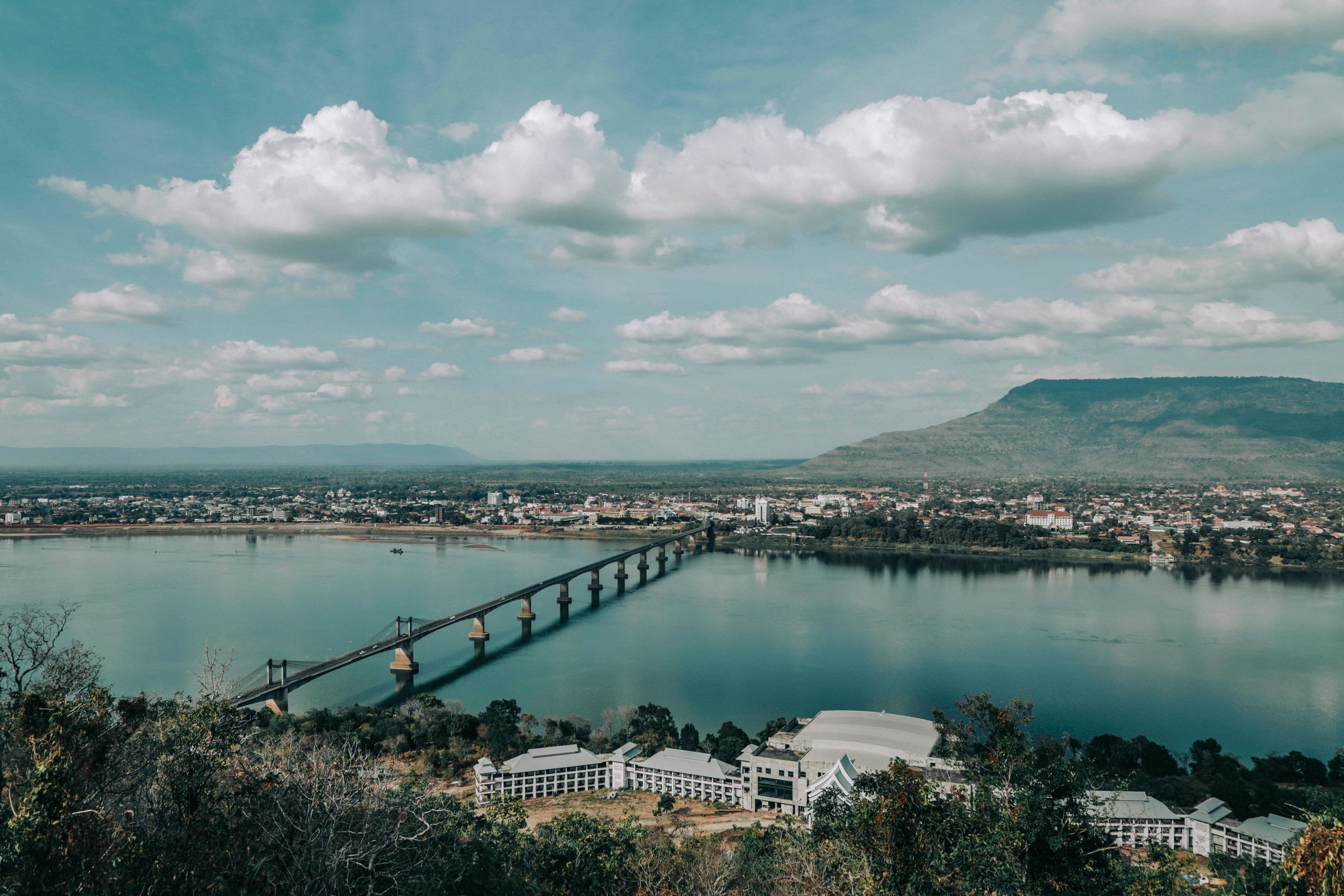
The 1994 First Thai-Lao Friendship Bridge connects Vientiane to Nong Khai, Thailand — the most important land border in Laos and the single most common entry/exit point. The crossing itself is a quick 10-minute shuttle bus ride ($0.75) once you're on it, but processing both immigrations takes 1.5-3 hours during peak weekends and Thai/Lao holidays. The Nong Khai side has direct night-train connections to Bangkok (12 hours, $25-50). Many travelers cross the bridge as a half-day Vientiane add-on for a brief Nong Khai morning market visit + Thai temple loop and same-day return. Visa on arrival available both directions for most passports.
Mekong River Cruise Dinner (sunset longtail)
Multiple operators run a 90-minute sunset dinner cruise on a wooden longtail from the Fa Ngum riverbank, departing 17:00-17:30. Two-tier setups: budget shared cruise $8-12 per person (BYO drinks and food from the market, plastic chairs, no service); mid-range with Lao set dinner $25-35 (laap, papaya salad, sticky rice, grilled fish, Beerlao included). Booking 1-2 days ahead at the Wat Chan boat pier or via Tripadvisor. The river is slow and wide here; cruises stay within 5 km of the city skyline. Not as dramatic as Luang Prabang's Mekong but a relaxing evening + restful sunset viewing.
Food, Markets & Street Eats
Talat Sao Morning Market (since 1899)
Vientiane's main commercial market since 1899, occupying a multi-storey complex on Lane Xang Avenue. The 'morning market' name is now a misnomer — it runs 7:00-18:00 daily. Ground floor: gold and jewelry. Upper floors: Lao silk weaving (sinh skirts $30-150, scarves $8-25), traditional herbs and medicines, and the textile market with hill-tribe Hmong and Akha embroidery. The food court on the back side has $1-2 noodle bowls, $0.50 fresh coconuts, and a daily papaya-salad pounding queue. Negotiate gently on textiles (10-15% off, not 50%); fixed prices on gold by weight. Cash only.
Khua Din Market (local everyday market)
The actual local market — chaotic, sprawling, completely unfiltered. Wholesale fresh produce in the early morning (4:30-7:00), retail noodle stalls, jungle herbs, dried river fish from the Mekong, fresh banana flowers, frog legs, sticky rice traders, and Lao charcuterie of every description. Not curated for tourists — you'll see live frogs and turtles, fresh blood-pudding sausage, and unfamiliar offal. Smelly, hot, fascinating. The food court at the back has Vientiane's best $1.50 khao piak sen rice noodle soup. Adjacent to the main long-distance bus station — many provincial bus passengers stop in here for breakfast.
Khop Chai Deu (since 1995, Nam Phou)
The reference Lao-international restaurant in Vientiane, occupying a restored colonial mansion on Nam Phou fountain. Open since 1995 — the city's longest-running tourist-and-local restaurant. Their menu spans Lao standards (larb $5, or lam $6, mok pa $7), Thai favorites, Vietnamese pho, plus pizzas and burgers for fussy travelers. The beer garden out back is open until 22:30 (city curfew applies) with Beerlao $1.80 and Lao BBQ sin dat $9/person. Friday-Saturday live music. Not the most authentic Lao food in town (Doi Ka Noi is better for that) but the most reliable all-purpose meal, especially with mixed groups.
Doi Ka Noi (authentic Lao home cooking)
The most authentic Lao restaurant in Vientiane, recommended by every food-focused expat in town. Owned by chef Sengtian, a former personal chef to embassy diplomats, in a small house on Sokpaluang Road. The menu is short, changes daily, and is what Lao families actually eat at home: laap with off-cuts and forest herbs, jaew bong chili dip, mok pa Mekong fish in banana leaf, or lam stew with sakhaan pepper-vine wood (the bark adds a tongue-tingling note unique to Lao food), and the 'Pom Lao Caesar' salad of Lao herbs with sticky rice croutons. Dinner only, walk-ins risky — book ahead on Facebook. Budget $20-35 per person with drinks.
Cafes, Bakeries & Brunch
Naked Espresso (specialty coffee on Setthathirath)
The reference specialty coffee bar in Vientiane, on Setthathirath Road in the Old Quarter. Australian-trained baristas, La Marzocco machine, single-origin Bolaven Plateau beans roasted in-house. Espresso $2.50, single-origin pour-over $4, Lao iced coffee (with condensed milk and ice) $2.80. The pastry case has croissants, cinnamon rolls, and Vientiane's only acceptable cheesecake. WiFi is fast (rare in Vientiane), power outlets at most tables — this is the digital-nomad office of choice. Two locations: Setthathirath (original) and Don Nokkhoum on the riverside.
Joma Bakery (Mekong-view chain on the riverside)
A Canadian-Lao bakery-cafe chain that's the digital-nomad default for breakfast and lunch — open since 1996, four Vientiane locations (Setthathirath, Phonxay, Vat Mixay, and Mekong riverside). Solid Western breakfasts ($5-9 — eggs Benedict, breakfast burrito, granola bowls), proper espresso ($2-3), sandwiches on house-baked bread ($4-6), and the best Mekong-view seating at the riverside branch. WiFi fast, AC strong, family-friendly. Slightly pricier than local options but the kid-and-laptop-friendly atmosphere is the appeal. Open earliest of any cafe in Vientiane (7:00 daily).
Le Trio Coffee (specialty riverside)
A small specialty coffee bar on the Mekong promenade, popular with younger Lao professionals and visiting Thai tourists. The Vietnam-inspired cà phê sữa đá ($2.50 — iced coffee with condensed milk) is the local favorite; pour-over from Bolaven and Indonesian single-origins ($3.50-4.50). Compact terrace with about 8 tables — gets full 9:00-11:00 weekends. Pastry case is small but well-curated (almond croissants $1.80, pain au chocolat $1.50, brownies $1.50). Owners are passionate baristas — happy to chat about Lao coffee origins. Quieter than Naked Espresso, similar quality.
Common Grounds (Australian-style brunch)
Vientiane's best brunch spot — an Australian-Lao cafe on Phonxay Road serving the menu Sydney commuters know cold: smashed avocado on sourdough ($6.50), eggs Benedict ($8), big breakfast plate ($9.50), and flat whites ($3) made with Bolaven Plateau espresso. Open-air patio with garden seating, slow ceiling fans, AC indoor section. The expat crowd's Saturday morning default. Booking helpful 9:30-11:30 weekends. The on-site small shop sells imported Australian wine, cheese, and Lao craft beer — limited but the only place in town for these.
Day Trips & Overnight Add-ons
Vang Vieng (1h45 by LCR train, hot-air balloon + Blue Lagoon)
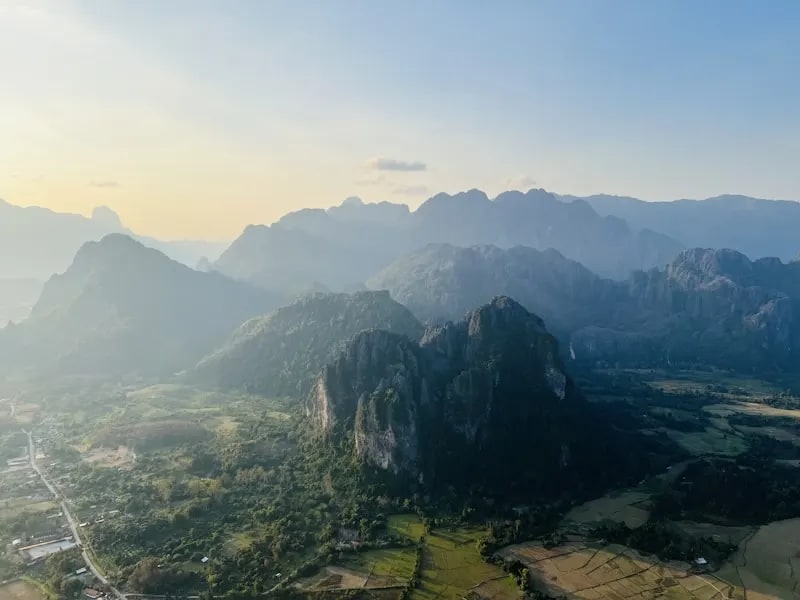
The 2021-opened China-Laos Railway (LCR) makes Vang Vieng an easy day trip — 1h45 each way on the bullet train ($14-20 each way 2nd class, $25-30 first class). Once a notorious party-tubing town, Vang Vieng has shifted since 2012 toward outdoor activities: hot-air balloon over the karsts at sunrise ($85 — Laos's single best photo opportunity), kayaking the Nam Song river ($15-25), Tham Phu Kham cave + Blue Lagoon 1 swimming ($5-8), motorbike tour through karst valleys ($20). Day trip is technically possible (06:30 LCR out, 20:00 LCR back) but rushed; overnight is much better — the dawn balloon launch is the actual reason to go.
Luang Prabang (2h by LCR train, UNESCO heritage)
Laos's UNESCO World Heritage former royal capital, 320 km north of Vientiane. Pre-LCR (before 2021), the road trip was 9-11 hours of mountain switchbacks. The new China-Laos Railway covers it in 2 hours ($30-50 2nd class, $50-75 first class). 3 nights minimum for Luang Prabang: Tak Bat dawn alms procession + Wat Xieng Thong + Mount Phou Si sunset + Kuang Si Falls swim + Pak Ou Caves Mekong boat. This is the canonical northern Laos add-on from Vientiane and absolutely worth the trip. Lao Airlines also flies VTE-LPQ in 50 minutes ($90-130 each way) — faster than LCR but books out further ahead.
Nong Khai, Thailand (Friendship Bridge half-day)
A quick half-day Thai border-town trip — cross the 1994 Friendship Bridge ($0.75 shuttle bus, 1.5-3h border processing total), visit Nong Khai's Tha Sadej riverside market, the Sala Keoku sculpture park (Bunleua Sulilat's sister site to Vientiane's Buddha Park, with even larger and stranger concrete figures), and the Indochina Market on the Thai side for cheaper Thai snacks, Thai SIM cards, and Western groceries unavailable in Laos. Same-day return easy. Most travelers do this as a half-day add-on rather than overnight; if you do overnight, the rooftop swimming pools at Mut Mee Guesthouse ($25-50/night) on the Thai riverbank are a legendary backpacker spot.
Night Views & Sunset
Patuxai rooftop (city panorama)
Vientiane's best panoramic view, from the 7-storey internal staircase of the Patuxai victory arch. 360° vista: the long ceremonial sweep of Lane Xang Boulevard pointing toward Pha That Luang's gold dome, the Mekong in the distance toward Thailand, and on clear winter days the limestone karsts of the Phou Khao Khouay range to the east. Best at sunset (17:30-18:15 cool season, 18:15-18:30 summer) when the western light catches Pha That Luang. Rooftop closes at 17:00 strictly — for actual sunset you need to climb by 16:30 and accept that the descent will be through dim staircases.
Bor Pennyang (rooftop bar above the Mekong)
Vientiane's most famous rooftop bar — a 6-floor walk-up on Fa Ngum Road with a wraparound terrace overlooking the Mekong. The view is unbeatable: directly across to the Thai bank, with the Friendship Bridge visible on a clear evening. Beerlao $2.50, cocktails $4-7, basic Lao bar food (sin dat BBQ skewers $1.50, papaya salad $2.50). The vibe is backpacker-dominated, music loud, and the prices double those of street-level riverside vendors — but the view is the attraction, not the value. Open until 23:00 (city curfew). Best 17:00-19:30 for sunset; mostly tourists.
Crowne Plaza Vientiane rooftop
For an upscale sunset alternative to backpacker bars, the Crowne Plaza Vientiane's 16th-floor rooftop pool deck is the only proper high-rise vantage in the city (Vientiane's height restrictions cap most other buildings at 4-5 storeys). Pool access $15-20 for non-guests with one-drink minimum; the open-air bar serves cocktails $7-10 and proper Western and Lao bites $8-15. The panorama is excellent — Mekong, Patuxai in the distance, Pha That Luang on a clear evening. Quietest 16:30-18:00 for sunset. The hotel itself is the city's newest 5-star ($180+/night) and worth knowing about for accommodation.
Travel cost
Per person, per day (excludes flights)
Hostel + local food + public transport
$22
Per person / day (excl. flights)
📅 Total cost by trip duration (incl. flights)
3 days
$100
5 days
$160
7 days
$220
Flight estimate: $800-1,500 from US/EU via BKK or HKG; $150-400 from Asia (VTE direct from BKK Bangkok Airways/Lao Airlines/Thai/AirAsia; SIN Lao Airlines; KL AirAsia; HAN Vietnam Airlines/Lao Airlines) (round-trip estimate)
Monthly weather
Currently in Vientiane: ☁️ 27°C
Vientiane now (Jun)
High 32°C / Low 24°C· Very Hot
Jan ☀️
High 28°C / Low 14°C
Hot
★ Best time to visit
Feb 🔥
High 31°C / Low 17°C
Hot
★ Best time to visit
Mar 🔥
High 33°C / Low 21°C
Very Hot
★ Best time to visit
Apr 🔥
High 35°C / Low 24°C
Very Hot
May 🔥
High 33°C / Low 24°C
Very Hot
Jun 🔥
High 32°C / Low 24°C
Very Hot
Jul 🔥
High 31°C / Low 24°C
Hot
Aug 🔥
High 31°C / Low 24°C
Hot
Sep 🔥
High 31°C / Low 23°C
Hot
Oct 🔥
High 30°C / Low 21°C
Hot
Nov ☀️
High 29°C / Low 17°C
Hot
★ Best time to visit
Dec ☀️
High 27°C / Low 14°C
Pleasant
★ Best time to visit
Jan
☀️
28°
14°
Hot
★Best
Feb
🔥
31°
17°
Hot
★Best
Mar
🔥
33°
21°
Very Hot
★Best
Apr
🔥
35°
24°
Very Hot
May
🔥
33°
24°
Very Hot
Jun
🔥
32°
24°
Very Hot
NOW
Jul
🔥
31°
24°
Hot
Aug
🔥
31°
24°
Hot
Sep
🔥
31°
23°
Hot
Oct
🔥
30°
21°
Hot
Nov
☀️
29°
17°
Hot
★Best
Dec
☀️
27°
14°
Pleasant
★Best
Practical information
Getting there
Getting around
Money & payments
Language
Cultural tips
Money & payment
Currency
Lao Kip (LAK). 1 USD ≈ 21,500 LAK (2026 rates). USD and THB widely accepted at hotels, tour operators, restaurants; LAK for tuk-tuks, markets, and anything under $5.
Card acceptance
4-5 star hotels (Crowne Plaza, Settha Palace, Salana) + a handful of high-end restaurants (Manda de Laos, Khop Chai Deu, Le Banneton) + Talat Sao Mall. Cash USD/THB/LAK for everything else — guesthouses, street food, markets, tuk-tuks, temples, day-trip operators.
Tipping
Not customary historically but increasingly appreciated. 10% at sit-down restaurants if no service charge added, $1-2 for tuk-tuk drivers on long routes, $3-5 per day for tour guides, $2-3 for spa therapists. No tipping at street stalls or markets.
ATM
BCEL Bank + LDB Bank ATMs in the city center charge LAK 30,000-50,000 ($1.50-2.50) per foreign withdrawal plus your home-bank fees. The best USD/THB → LAK rate is at BCEL or LDB Bank branches (not the ATMs themselves) — airport changers and hotel desks run 5-7% worse. Bring USD cash to change at BCEL teller windows for the best rates.
Recommended itinerary
Vientiane 2-day route
Day 1 City temples + Patuxai
09:00
Pha That Luang (great gold stupa)
Laos's most important national monument; ¥10,000 ($0.50)
11:00
Patuxai (Laotian Arc de Triomphe)
1957-1968 + American cement intended for airport; ¥3,000 ($0.20)
13:00
Lunch at Lao Kitchen (modern Lao)
Larb + tam mak hoong ¥80,000-150,000 ($4-7)
15:00
Wat Si Saket (oldest surviving temple 1818)
10,000 Buddha statues + cloister; ¥5,000
17:30
Mekong sunset at Riverside
Sun sets over Thailand; cocktails at Bor Pen Nyang ¥40,000
20:00
Dinner at Makphet (training restaurant)
Underprivileged youth training + modern Lao ¥150,000-250,000 ($7-12)
Day 2 Buddha Park + departure
09:00
Bus to Buddha Park (Xieng Khuan, 25km south)
Bus #14 from Talat Sao ¥10,000 / 1h
10:30
Buddha Park surreal sculptures
1958 Hindu-Buddhist + giant reclining Buddha + 3-story pumpkin; ¥15,000
🎫 19% off — Book lowest price12:30
Lunch at Buddha Park café
Lao food + drinks ¥80,000
15:00
Return to Vientiane + COPE Center (UXO awareness)
Sobering exhibition on cluster bombs from Vietnam War; free + donations
18:00
Final Mekong sunset
Cocktails at Spirit House riverside ¥40,000-80,000
20:00
Final dinner at Doi Ka Noi (Burmese-Lao fusion)
Modern Lao + Burmese fusion ¥120,000-200,000 ($6-10)
Where to stay
Click each district to compare hotel deals
City center (around Patuxai)
French colonial boulevards + cafés + boutique inns. Best base.
See hotels in this area
Mekong Riverside
Sunset spot + restaurants + cocktail bars. Premium location.
See hotels in this area
Wat That Luang area
Around great gold stupa + quieter + cheaper guesthouses.
See hotels in this area
That Khao
Local district + cheaper accommodations + 10-min tuk-tuk to center.
See hotels in this area
Settha Palace area
Heritage Settha Palace Hotel + colonial luxury.
See hotels in this area
Nong Khai Thailand (across river)
Stay in Thailand side + cheaper + day visit Vientiane via Friendship Bridge.
See hotels in this area
Vientiane hotel price comparison
Compare Booking.com, Expedia, Hotels.com prices in one place
* Centered on City center (around Patuxai) — the most hotel-dense area in Vientiane
Top tours & activities in Vientiane
Top-rated by travelers
Frequently asked questions
Most common questions from travelers to Vientiane
Q How much does a day in Vientiane cost?
Budget $22/day with guesthouse + market and street food + sticky rice meals + walking + occasional tuk-tuk. Mid-range $50/day with boutique hotel + Khop Chai Deu or Doi Ka Noi dinner + Buddha Park tuk-tuk + a few entry fees. Luxury $115+ at Crowne Plaza or Settha Palace + fine dining + private guides. Among the cheapest national capitals in Asia — roughly half the daily cost of Bangkok, two-thirds of Phnom Penh, one-third of Singapore.
Q How many days do I need in Vientiane?
2 nights is the sweet spot for most travelers. Day 1: Wat Si Saket + Haw Phra Kaew + Patuxai rooftop + Pha That Luang + Mekong sunset on Fa Ngum + Night Market dinner. Day 2: Buddha Park (Xieng Khuan) half-day + COPE Visitor Centre afternoon + Wat Si Muang + Doi Ka Noi or Khop Chai Deu dinner. Add 1 more night if you want to slow down or do a Mekong cruise. The city itself is small — more than 3 nights and you'll be looking for excuses. Most travelers pair Vientiane with Vang Vieng (1h45 by LCR train) and/or Luang Prabang (2h by LCR train) for a 5-7 day Laos loop.
Q When is the best time to visit Vientiane?
November-February is the prime window — cool dry season (18-30°C day, 15-18°C night, low humidity, perfect for temple-walking and Mekong sunset). March-May is hot dry season (up to 35°C, agricultural-burn haze in March-April drops air quality to unhealthy levels in some weeks). June-October is the wet monsoon (31-33°C, daily afternoon thunderstorms, 85% humidity, occasional power cuts). The November That Luang Festival (full moon of the 12th lunar month, typically early-to-mid November) is the cultural high point of the year — the entire city focuses on Pha That Luang for a week of candle processions and trade fair. Lao New Year (Boun Pi Mai, April 13-15) brings citywide water-pouring rituals but extreme heat and most businesses close for 3-4 days.
Q Do I need a visa for Vientiane?
30-day visa-free for most passports as of 2025 — including all ASEAN, EU, US, UK, Australia, Japan, Korea, Canada. Just present your passport (6+ months validity, 1 empty page) at the immigration counter and get a free stamp. For non-exempt nationalities, e-Visa is the easiest option at laoevisa.gov.la — $50, 3-5 working days processing, skip the airport queue. Visa-on-arrival (VOA) at Wattay International also available — $30-45 depending on nationality, USD cash + 1 passport-sized photo required. Friendship Bridge land border issues VOA for most nationalities but the queue can be 1.5-3 hours during weekends and Thai/Lao holidays.
Q Is Vientiane safe for tourists?
Yes — one of the safest national capitals in Asia. Violent crime against visitors is essentially nonexistent. Petty risks: bag-snatching from motorbikes on Setthathirath and Lane Xang Avenues (carry bags on the building side, not the curb side), tuk-tuk fare overcharging (fix prices in LAK upfront), and occasional pickpocketing at the Night Market crowds. Main practical risks: road traffic accidents on rented scooters (no helmet enforcement, rough roads, no insurance for unlicensed riders), waterborne stomach issues if you drink tap water (always bottled), and dengue / Japanese encephalitis mosquitoes in monsoon (use repellent dusk and dawn). Solo female travelers consistently report Vientiane as one of Asia's most comfortable solo destinations day or night.
Q Does English work in Vientiane?
Yes for tourism — hotels, tour operators, mid- and upper-tier restaurants, taxi drivers near tourist sites, and most cafes all operate in English. Below that level (street food vendors, family guesthouses outside the Old Quarter, market sellers, public bus conductors) it drops to basic English plus gestures plus Google Translate. French is still understood by some older Lao residents from the colonial generation. Thai is widely understood — Lao and Thai are about 70-80% mutually intelligible, so a phrasebook in either will work. You'll do fine with English alone for any standard tourist itinerary.
Q What food is Vientiane famous for?
Lao cuisine is the underrated highlight of any Laos trip. Iconic Vientiane dishes: larb (the national salad, minced pork/chicken/buffalo with mint, lime, chili, and toasted rice powder, $3-6, eaten with sticky rice using your right hand), tam mak hoong (Lao papaya salad — more pungent than Thai som tam because of pa daek fermented fish sauce, $2-3), khao piak sen (chicken-broth rice noodles, $1-2 breakfast at Khua Din Market), or lam (the spiced buffalo or chicken stew with sakhaan pepper-vine wood, $4-7), mok pa (Mekong fish steamed in banana leaf, $4-7), kao jee patê (the colonial French baguette sandwich with pork pâté, herbs, and chili, $1.50-2.50), and Lao BBQ sin dat (DIY hot-pot-meets-grill, $6-10/person). Beverages: Beerlao ($1.50-2 — locals call it Asia's best lager), Lao-Lao rice whisky ($2-3 — strong), Bolaven Plateau coffee at Naked Espresso ($2.50-4). Best restaurants: Doi Ka Noi (authentic Lao, $20-35 tasting menu), Khop Chai Deu (Lao-international, $5-15), and Manda de Laos (fine-dining colonial setting, $25-45).
Q How do I get around Vientiane?
The Old Quarter is 100% walkable — end to end in 25-30 minutes. Bicycle rental $2-3/day covers the wider city. Tuk-tuks for out-of-quarter trips: $1-2.50 within the city center, $8-12 round-trip shared to Buddha Park, $4-6 round-trip to Pha That Luang. Loca ride-hail app works in Vientiane (not Luang Prabang) with fixed rates and card acceptance — most reliable option for fare predictability. Public bus #14 from Talat Sao to Buddha Park $0.60 one-way (cheapest but slowest, 1h15). Scooter rental $10-15/day available but requires an international driving permit and police checkpoints are common. No Uber, Grab is not available in Laos.
Q Vientiane vs Luang Prabang — which should I visit?
Both if you have 5+ days — they are completely different cities and the LCR train links them in 2 hours. Vientiane: national capital, cheaper, larger, more colonial-French, less touristy, 2 nights enough. Best for: Mekong sunset, gold stupa, surreal Buddha Park, COPE history. Luang Prabang: UNESCO peninsula, more atmospheric, more expensive, more religious, 3 nights minimum. Best for: Tak Bat sunrise alms procession, Kuang Si Falls swim, Wat Xieng Thong, Pak Ou Caves Mekong boat. If forced to choose only one: Luang Prabang has more depth and is dramatically more photogenic, so first-time Laos visitors typically prioritize it. Vientiane is the better choice if you only have 2-3 days, want a cheap budget Asia stop, or you're transiting between Thailand and Vietnam.
Q Is Vang Vieng worth visiting from Vientiane?
Yes if you have 2+ extra days. The new 2021 China-Laos Railway makes it a 1h45 train ride ($14-20 each way). Vang Vieng's tubing-and-party era has been over since 2012 — the town has shifted to outdoor activities: hot-air balloon over the karsts at sunrise ($85 — the single best photo opportunity in Laos), kayaking the Nam Song river ($15-25), Blue Lagoon swimming ($5-8), motorbike tours through karst valleys. Day trip is technically possible but rushed; 1-2 night overnight is much better because the dawn balloon launch is the actual reason to go. Skip if you only have 2 days total in Laos or aren't into outdoor activities — Vientiane and Luang Prabang are stronger uses of limited time.
Q What is the COPE Visitor Centre and why does everyone recommend it?
COPE Visitor Centre (free, Khouvieng Road, 8:30-18:00) is the most important museum in Laos — and the one site nearly every traveler calls the highlight of their Vientiane stay in retrospect. It documents the US 'Secret War' bombing campaign of 1964-1973, during which 270+ million cluster submunitions were dropped on Laos, making it the most-bombed country per capita in human history (more tonnage than was dropped on Germany and Japan combined in WWII). An estimated 80 million bomblets still lie unexploded across the countryside; UXO Lao clearance teams have been working since 1996 but face decades more work. The center is co-located with the rehabilitation workshop that fits prosthetic limbs to UXO survivors. Quiet, sobering, exceptionally well-presented in English. Allow 60-90 minutes. Donations strongly encouraged. The on-site shop sells jewelry made by clearance workers from recycled bomb-casing aluminum ($15-50) — genuinely the most meaningful souvenir purchase available in Laos.

TripPick
Data-driven travel guide
Weather and exchange rates on this page are fetched live from external APIs; cost and itinerary data are verified periodically against local sources.
Weather
Open-Meteo API
Exchange
ECB rates
Costs
Local price data
Itineraries
Traveler reviews
Book your Vientiane trip
Compare flights, hotels, and tours all in one place
Prices via Skyscanner, Booking.com, GetYourGuide
Go deeper into Vientiane
Click each topic for the dedicated guide
Similar to Vientiane
Same region, similar climate and budget